The Stalactites Cave (Me’arat HaNetifim), also known as the Soreq Cave, is a carstic cave that is situated on the western slopes of the Judean Mountains, near the city of Bet Shemesh. The Stalactites Cave was created by the trickling of rain water that has dissolved the limestone, and it includes all existing stalactites formations, some of which have been dated as 300,000 years old at least. The cave’s sediments also create a variety of naturally occurring shapes. Many areas inside the Stalactites Cave are still active and the stalactites and stalagmites in it are still growing. The climb down into the Stalactites Cave goes through a 150 stairs and the views, as you can see, are magnificent.
Surprisingly, it’s not a pick-up line. It’s the theme of the new Starbucks handcrafted soda line. These are designed to be refresher beverages, fruit drinks made with real sugar (not corn syrup) and infused with carbonation. I had the opportunity to sample many of the flavors today, and although I wasn’t transported into a past childhood playground – or drawn into an adult fantasy playground for that matter – it was fascinating to taste what passed the development and marketing tests to make it into the stores.
The Bad
My first taste was not encouraging. It was Lime and I immediately thought it would be better used as a palate cleanser than a refreshing beverage. The Berry Hibiscus was only slightly better, but had the unique ability of being slightly addictive in spite of it’s questionable flavor. The Root Beer could have been a Sassafras Tea gone bad: it may be more medicinal than tasty.
The Good
The Lemonade took me back to France, where Limonade is supreme (Now this is a playground I can appreciate). But the best by far was the Orange. I expected it to be a take-off on Orangina, but it was much more. There was a burst of Mandarin Orange to make your taste buds spin.
Like so many of the Starbucks drinks, these refreshers are overpriced for what you get, so I’m not certain I’d set out to intentionally purchase one, but to cool down on a hot day these drinks are a viable option. They definitely were not the bully on the playground, leaving you disappointed and betrayed, miserable in a time of fun, and yet I’d stick with the comfortable friends. I’d rather pay a price for a satisfying flavor than a stomach elixir.
Facilities Management is an industry that primarily goes unnoticed until something goes wrong, and then it becomes understood that this industry is the backbone of business. If it didn’t exist nothing would function as we know it.
Today I venture out to Jerusalem on my own. My thoughts are crowded, my emotions strung tight; I’ve been through a challenging couple of days. As I sit alone in the train, staring out the window at the passing landscape, I remember it’s my dad’s birthday.
It’s been twelve years since I found him unconscious, the victim of a massive stroke. I had my mother with me then, my hero, my friend. She was my glue. Now she’s gone too…and I’m on a train to the Holy Land. I wish I could tell them what’s going on, what I’m feeling; I wish I knew what they would say, what they would think. I could really use their insight.
I miss them. I miss my parents.
Tower of David
Daddy wasn’t really into church when I was young. He never stopped Mother from taking us, never argued our beliefs. He just couldn’t be a part of it. He’d lost faith along the way, a little lost beneath the hand of his father, a little more as a tortured WWII soldier in a Nazi prison camp, and even more as a police officer who experienced a little too much of the dark side of human nature. He had a hard time forgiving himself. It wasn’t until he was paralyzed by the first stroke that he started to come to terms with who he was as a man and started to search for God again.
I’m on that journey myself. I can’t forgive myself. I can’t forget. I lost my faith, and I’ve never needed it more than I do now.
I entered the old city by way of Jaffa Gate. As I stood at the busy entrance, the Tower of David to my right and the start of the Bizarre straight ahead, I knew I needed to get my bearings, to choose my path. I stopped for coffee at a Christian cafe on the corner and looked through my travel app.
Lions Gate
I wanted to walk the Via Dolorosa, the way of grief and it seemed appropriate to start my day there. It starts at the Lions Gate on the opposite side of the ancient city, so I made my way there through the narrow, crowded alleyways.
The Old City of Jerusalem was originally built in 1004 B.C.E. by Kind David, the man after God’s own heart, the boy of great faith and courage, the man of great shame and even greater honor. This city he built has been known as the center of the world. Ancient maps show three continents: Europe, Asia and Africa, situated in a circle with Jerusalem at the center. Since then Jerusalem has been cherished and glorified by Kings and conquerors. This is the land of my spiritual heritage.
The Via Dolorosa consists of 14 stations marking the path of Jesus during the last hours of his life. They are based on events that occurred along the way to Golgotha where He was crucified. I know the story well and yet as I look around me, I feel a tremor of expectation and foreboding.
It’s not as if I believe being in the land will bring me closer to God or that the location itself possesses a magical power, but I cannot deny this is having an impact beyond what I expected. Being able to see, touch, feel…to experience this journey – even with all of the changes brought by time – take it beyond a story or a vision on a screen. It removes some of the ideas and assumptions of common thought to add a true perspective, which personalizes it.
Station 1 is located on the north-west corner of the temple mount. This is the present position of the Al-Omariya school. In Roman times this was the place of the seat of Pontius Pilate, located in the Antonia fortress, and the place of the hall of judgment.
As I stand in the school yard and look into the plaza I imagine the crowds that day when Pilate asked who should be set free by popular acclaim that Passover day, as was custom.
The Church of Flagellation
“Give us Barrabas,” they cried. And he was set free.
Jesus was condemned to death that day, and even Pilate knew there was something wrong with that choice. The Bible says he turned and washed his hands of the blood of this innocent man.
I’m not innocent; I have made many mistakes. But I do know the pain of being falsely accused, of being misunderstood, of being betrayed. The tears well in my eyes as I think of how I feel in my much lesser experience, how He must felt at the gravity of what He would face. I consider the sentence placed on him that was greater than any punishment I could ever know, greater than He deserved. And yet he was born for just this purpose, this horror. This was the final leg of his destiny on earth.
Station 2 is near the compound of the Franciscan monastery. This is where Jesus was beaten and where He received the cross.
There are two churches in the compound: The Flagellation and The Condemnation. The interior of the churches house remarkable stained-glass windows and statues that illustrate the events of the conviction, flogging, the soldiers placing a crown of thorns on his head, and the cross being placed on His back.
There’s a post in the plaza between the churches that is like the one Jesus would have been strapped to as the soldiers scourged him. The tour groups have dispersed and I stand alone in the plaza. In the silence I can almost hear the echoes of the mocking voices, the crack against His skin, His painful cries. I can imagine the blood that spattered the stones and the crowd that watched.
I sit down on the cobbled ground and weep as I quote the words I’ve carried with me as promise for so many years.
“He was wounded for our transgression, He was bruised for our iniquities; the chastisement of our peace was upon Him, and by His stripes we are healed.”
Jesus Fell
I’ve always been taught that Jesus bore our sins and our sickness. He took all my shame and pain for himself so that I could know freedom and peace, so that I could walk with confidence. I need that freedom today; I need to know that forgiveness. I am beaten and lost. I need to know that love now, more than ever.
I can hear my Mother whispering a song in my ear and I find myself singing in a soft, broken voice: “Amazing grace shall always be my song of praise for it was grace the bought my liberty. I do not know just why He came to love me so. He looked beyond my faults and saw my need.” How could anyone love so much to not only give their life, but endure so much to ensure I would have a way to peace and victory?
Station 3 is located on the corner of via Dolorosa and El Wad (Hagai) street. This is the place where Jesus fell for the first time beneath the weight of the cross. The image of this has been carved at the entrance of the Polish church built here.
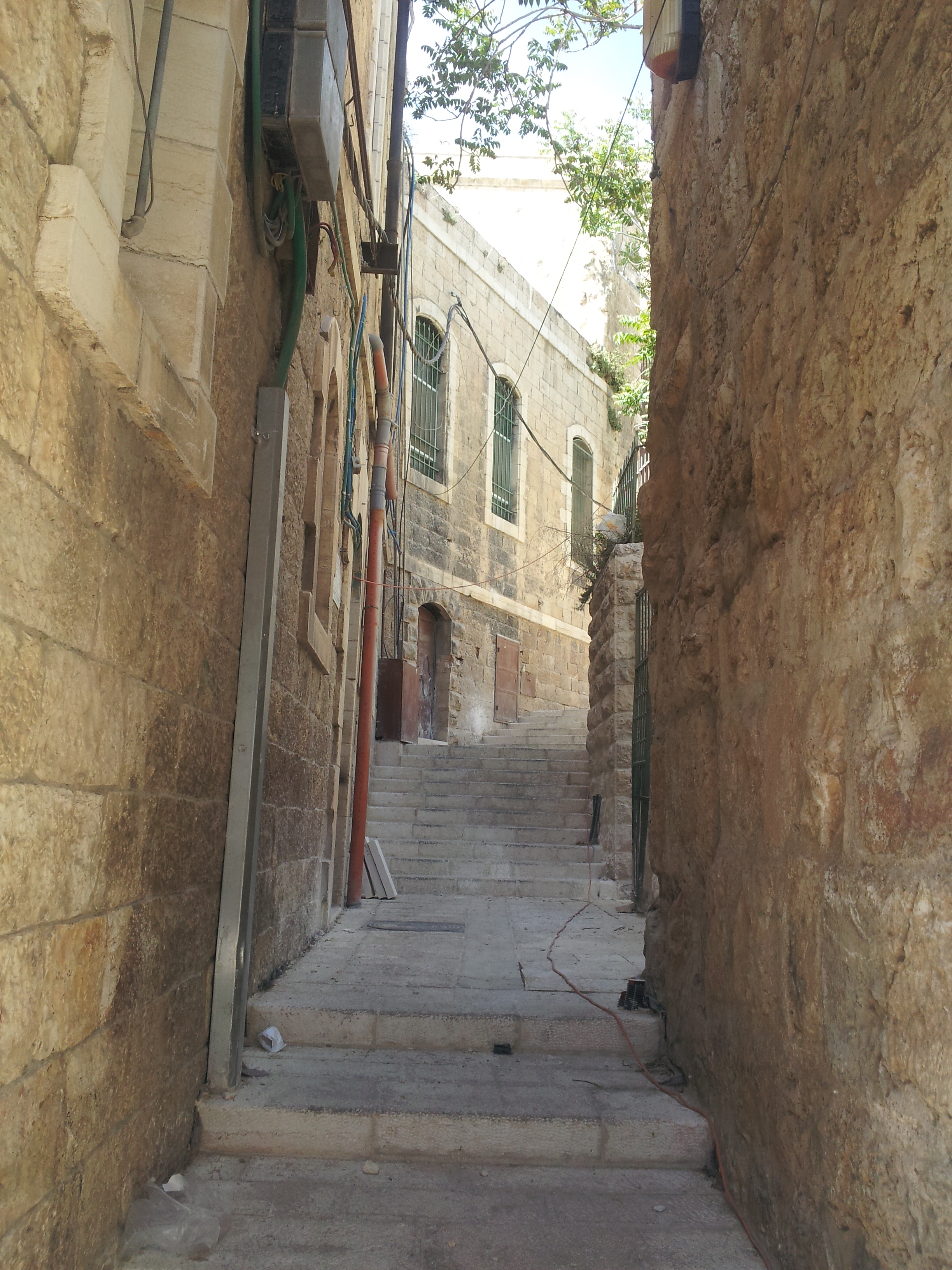
The narrow streets along the Via Dolorosa
Station 4 is where Jesus met his mother, Mary. She would have come from the small alleyway, pushing her way through the crowds, desperate to catch a glimpse of her son, to have one last minute with Him. She was there with John: “When Jesus therefore saw his mother, and the disciple standing by, whom he loved, he saith unto his mother, Woman, behold thy son!” (John 19:26)
He was being humiliated and shamed, cruelly mocked and struggling to carry the weight of the cross, and yet He had the presence of mind and the selfless spirit to seek assurance His mother would be cared for when He was gone. It’s a staggering thought. I can hardly stop thinking about my own pain; I can’t block out the words that haunt me or forget the bitter experiences. But then I think of the past year, when nothing mattered but my Mother and her needs. Nothing I thought or felt was as important as easing her pain, lightening her load…ensuring she would have a future.
At Station 5, Simon helped Jesus carry the cross. I look up at the road that turns sharply to the right and climbs up the hill through a series of stairs. I lean against the corner wall and take a sip of water.
I’m carrying a small backpack and I’m feeling tired beneath the heat of the sun and the pressure of walking on the cobbled stones at a staggered incline as I weave through the streets. Jesus hadn’t eaten, was weary from the previous night of betrayal, emotionally drained from the trial and the continued mocking, physically exhausted from the beating and blood loss…
Station 6: Veronica wipes the face of Jesus. An act of unexpected kindness. How we all search for them in our time of need, when we feel forgotten and forsaken. A small Greek Catholic Chapel commemorates the moment.
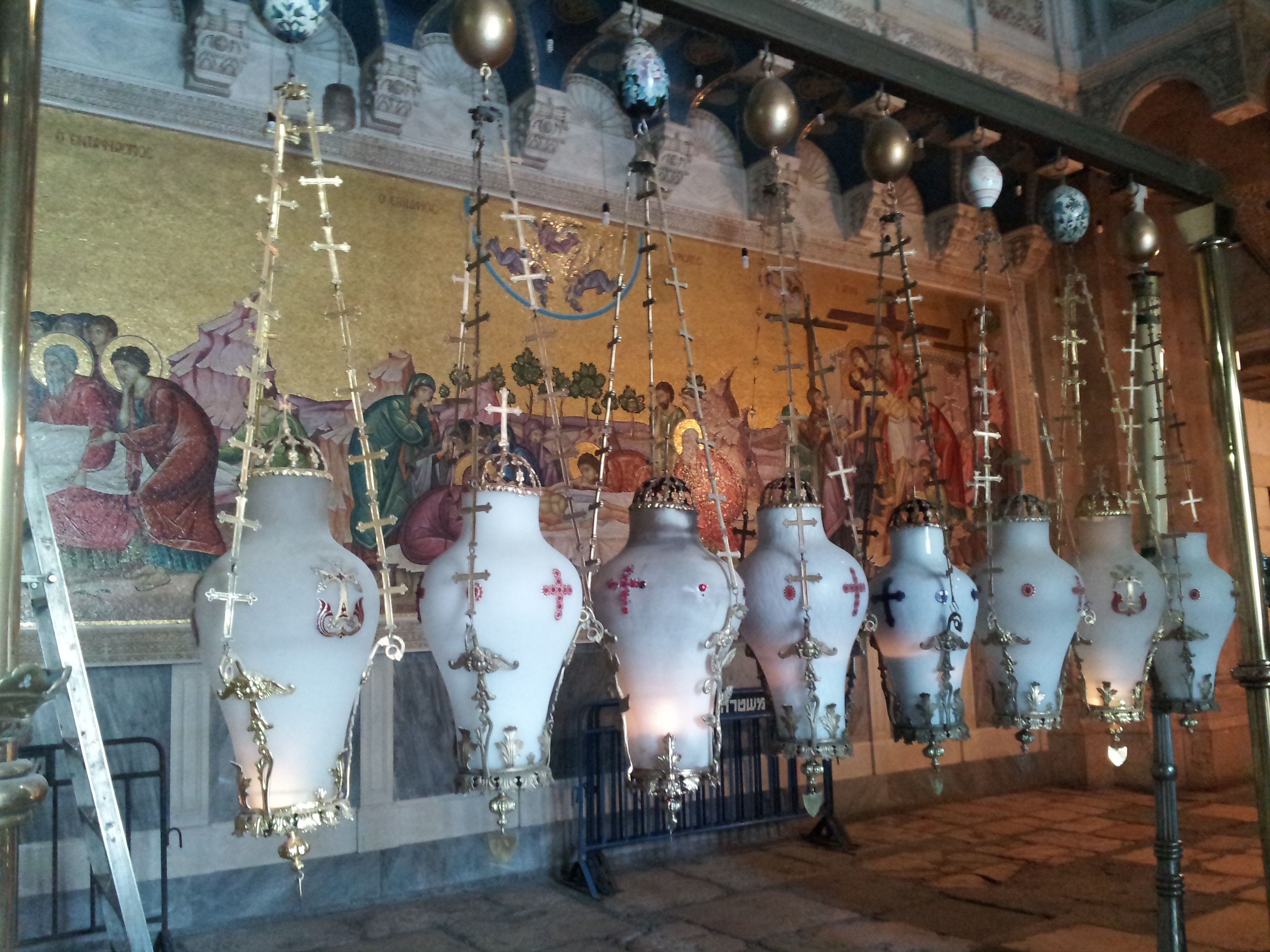
Lanterns in The Church of the Holy Sepulchre
Station 7: Jesus falls the second time. This is where Jesus passed through the Gate of Judgment. This is one of the busiest streets in the Old City it would seem, and it may have been during this time of Jesus. It was an intersection of the Cardo Maximus and a traverse street of the roman Aelia-Capitolina; in modern days it’s the intersection of via Dolorosa with Khan es-Zeit (the Oil Market). The way up the hill and the pressure of the city does not make for an easy walk. Of course Jesus fell. I wonder if I will.
Station 8 is based on Luke 23:27: “But Jesus turning unto them said, Daughters of Jerusalem, weep not for me, but weep for yourselves, and for your children.”
And at Station 9, Jesus fell for the third time. This is near the Church of the Holy Sepulcher, on a roof courtyard above the underground Armenian Chapel of St Helen and at the entrance to the Ethiopian church of St. Michael.
By now he would have been beyond critical blood loss. His strength would have been gone, his vision blurred and eyes blocked by the blood trickling from His brow. He must have been so ready for the pain to end.
Stations 10 – 14: Jesus stripped of His garments, nailed to the cross, dying, being taken down from the cross and taken to the tomb are all marked within the walls of the Church of the Holy Sepulcher.
Inside The Church of the Holy Scepulchre
The first Church of the Holy Sepulchre was approached by a flight of steps from the Cardo, the main street of Jerusalem. It was accessed through a narthex, a basilica and an open area (the holy garden), which had in it the rock of Golgotha. About 10 years after the crucifixion, a wall was built that enclosed the area of the execution within the city and separated the image of the skull from the city. (I would see the image of the skull in the landscape that gave Golgotha its name later. It is just outside the walls, and although protected, the view is blocked by a modern bus station.)
The church has been destroyed, rebuilt, captured, adapted, liberated and renovated by various religious and political sects many times throughout history. The church is richly decorated with structures, art, ornamentation and symbolic relics that mark various phases of medieval history, European imitations and Christian history. You can visit the Armenian chapel deep below ground level, and explore the Edicule on the main floor. There are beautiful mosaics, icons and lanterns, part of the rituals and reflections of the passion of Christ. Upstairs are Greek Orthodox and Catholic alters that mark the crucifixion. In all, six denominations celebrate their rites in and around this cavernous house of worship.
The church is significant in understanding contemporary Christianity and its complex history; it is certainly a living testimony to the tenacity of Christians to retain and honor their own piece of Jerusalem. But somehow I feel the personal connection to the Passion experience is lost in the elaborate embellishment and rituals, in the tension required for the varying religious groups to maintain their presence and reflect their heritage. I am immersed in the beauty and culture around me, yet it doesn’t hold the power to move me, to capture my heart as simply walking the steps of Jesus did.
It’s hard not to consider how this may actually reflect the impact of structured religion on society today. What began as a celebration, a proclamation of the gospel, and even a means of discipleship and growth has become a relic of history, a testament to the past, but not a true path to finding a deep, abiding relationship with God.
My via dolorosa
Jesus came to love. He walked among us, showing kindness and forgiveness, offering grace and mercy. He gave honor and respect, and was only relentless in sharing the love of God, not the dogma of religion.
As I leave the darkened hall of the church and squint into the sunlight, I know without a doubt I’d rather be remembered for love than arrogance; I’d rather fight for the experience of a loving relationship, than go to war for a symbol of it. My journey today has led me to a personal truth: though I am still in the midst of my via dolorosa, it doesn’t feel as meaningless and cruel. I’d rather walk the way of grief than sit in a hall of history or an emblem of fame.
Sustainability is by far the most common and on-going trend in Facilities Management.
Oh, how we love such buzz words!
Simply put, “sustainability” is the goal of meeting our current needs without compromising the abilities of future generations to meet their own needs. It’s all about environmental science in the workplace: energy, waste and water management against environmental impact. To stand out in the industry, a facilities manager must be committed to environmental stewardship and incorporating sustainable practices into day-to-day operations through programs such as recycling, energy efficiency measures, green landscaping, custodial services, clean energy and transportation to name a few.
Most Facilities Management teams have always focused on this because let’s face it, the financial gains as well as the health and safety benefits of pursuing green space cannot be denied. Over the last few years, it’s become mainstream. When something becomes mainstream, it results in yet another certification to acquire for credibility and proof that you know how to do your job.
LEED is an internationally recognized green building program. Participation in the voluntary LEED process demonstrates leadership, innovation, environmental stewardship and social responsibility.
What came first The FacMan or the LEED?
There had to be people already implementing measurable programs for the consensus-based program to become market-driven. Then the market demands a third-party verification standard for an “unbiased” evaluation, and BAM! Facilities Managers have a necessity for more letters connected to their names.
Don’t get me wrong. I’m not minimizing the importance of LEED programs or criticizing the certification credentials. Such certifications have given much needed attention and credibility to a career field often under-valued, if even recognized. But do they really confirm or deny the knowledge, efforts or initiatives currently in place for many Facilities Managers? Not always.
The project certifications however, provide benefits beyond personal career goals and objectives in the form of tax credits, zoning allowances and other government initiatives. Project certifications and professional credentials go hand-in-hand. This being the case, those letters have become a symbol of the trend…
Facilities Managers LEED the way to sustainability.
I remember when I first got into Facilities Management.
Well, I’d been in the field for years, but they called it “support services.” It wasn’t until I was actually managing the support staff and engineers that I found myself under the official umbrella. It didn’t bring much prestige. Most people seemed to think the facilities managers were the people in charge of Christmas decorations. Ironically, that was true.
It was the fall when I took on the position, and ultimately the task of refreshing the ancient decorations on a shoe string budget. I found myself in a large conference room stripping all of the wreaths down to the twisted wood vines and creating the new look. For several days, I clothed styrofoam balls, created bows and painted bells…and stood amazed that I was making such a fine salary off such a job.
That was before the drama started. It was before the awakening.
People still don’t immediately understand the role of Facilities Management. Wikipedia describes it as: an interdisciplinary field devoted to the coordination of space, infrastructure, people and organisation, often associated with business services functions, such as offices, arenas, schools, convention centers, shopping complexes, hospitals, hotels, etc. as well as non-core functions and activities related to the business.
*Crickets Chirping*
What does that mean?
To put it in more simple terms, Facilities Management is the field dedicated to creating and ensuring a functional environment, which includes people, place, process and technology.
I usually still get blank stares at this explanation, to which I quickly respond. “When you have a complaint and don’t know who to call, whether it be a clogged toilet, a leaky Liebert, a blown circuit, your phone is down or the vending machine doesn’t stock Nutty Bars, Facilities Management is the group you need to call.
That usually satisfies the basic question, but it doesn’t really express the insanity of the job. Anyone in the field can toss around terms like sustainability, risk management and efficiency control, and then explain construction projects, infrastructure design, support services and operating budgets are often their core functions, but the most time-consuming task for a facilities manager is simply dealing with people.
Facilities Managers are either the most grumpy and rude people you’ll ever meet, or they are the ones most likely to be laughing and dancing through the cubicle maze. Either way, they are rarely bored because there is no such thing as mundane in this job. If you are one who feels a sense of accomplishment at the end of the day when you see you’ve marked through the tasks on your checklist, this would not be the job for you.
Good intentions are paved with checklists.
A facilities manager will start the day off with 10-20 priority tasks that will become secondary to the black light bulb over reception or the foul smell on the executive floor…or the employee who’s colostomy bag burst in front of the mail room. We are jugglers of the unexpected, the disgusting, the novel and the senseless.
Tonight, Monday, October 3rd marks the House MD season 8 premiere. Twenty Vicodin Written by Peter Blake; Directed by Greg Yaitanes
When last we saw Dr. Gregory House (Hugh Laurie), he was smiling in relief after plowing his car into the home of his ex-girlfriend, Dr. Lisa Cuddy (Lisa Edelstein). Although meant to be a metaphorical ending – representative of breaking the chains of expectations, change, propriety and connection – the controversial finale instead brought a dark and tragic ending to a lack-luster season full of missed opportunities, unbelievable stories and disintegrated characterizations.
The House team has been teasing the fans for years with a Greg House who was progressively uncomfortable with life and misery, and was seeking to change. Yet even through a mental breakdown, time in a mental institution, detox from vicodin, regaining his medical license, rebuilding his medical practice, entering into an overdue and long-awaited relationship (they spent all of season 6 focused on House pining for Cuddy), experiencing the subsequent break-up, going back on drugs and falling into a debauchery that took the viewers beyond all realm of belief, there was no exploration into the House character or his issues beyond a desire to connect and a need to trust. With so much build-up and promise, the viewers needed to learn more about House and experience a little more emotional substance to support the abundance of shocking twists. The persistent focus on other characters and insignificant plots that did nothing to get inside the heart and soul of this complex character, left viewers increasingly frustrated and angry. The extremes of season 7, in conjunction with the unmet hopes for deeper emotional insight that should have been brought to the surface in a romantic relationship, proved to create a brand of animosity almost palpable for many viewers. Critics and fans alike were vocal throughout the season regarding their ever-increasing dissatisfaction. The finale was a blow that left many viewers feeling they simply could not tolerate anymore teasing and stagnancy from a character that had now been reduced to an unsympathetic shell of the anti-hero they’d been rooting for so many years.
The Season 8 premiere, Twenty Vicodin, begins with House in front of the parole board. In the first minutes, the viewer is subjected to a series of explanations, excuses and justifications for his violent act that are a complete regurgitation of the many interviews from show creator David Shore over the summer. I’m not certain if they believed the words would be more acceptable coming from the mouth of Hugh Laurie or the character of House, but it certainly continued to downplay the magnitude of the violence, attempted to ignore the significance of the act as more than just inappropriate and careless, and minimized the greater emotional and psychological trauma such an act causes for both the victim and the one-time aggressor (as they make it a point to stress). Nevertheless, as a result of overcrowding, House has the opportunity to make parole if he can behave himself for 5 days.
The episode is slow. It spends time establishing the various politics and power structures within the prison. The viewers are made aware through a series of scenes that House has learned to navigate the various sects and manipulate the system. He is more subdued than we’ve seen him since the first few episodes of the series. He is restrained, yet still smart mouthed, and continues to push the line of propriety even as he follows the rules set out before him by both guards and alpha prisoners. Unfortunately, the possibility of parole has now shifted the lines of power and new expectations are placed upon House. This, intermixed with the medical puzzle presented through a fellow prisoner, pushes House into situations and old behaviors that could risk his parole, and even his future both in and out of prison.
The patient of the week has a rash. Not interesting to Dr. House, but a trip to the infirmary during his daily janitorial chores – which of course leads to the introduction of new doctor, Dr. Adams (Odette Annabel) – draws House into a new puzzle. The patient of the week is interesting, even though the changing power dynamic with the inmates prove to distract from the case. As usual, there are several misdiagnosis and treatments before the final epiphany, but it allows more time to set some groundwork for the season.
Typical of House, he reads Dr. Adams almost immediately and uses his knowledge to manipulate his way into further involvement with the case. We understand immediately that House sees in the prison doctor an altruistic nature that frustrates as much as fascinates, but he’s most intrigued by her interest in the medical puzzle. This commonality would have felt like a good foundation for a future connection had it not been for the forced and cliché scene wherein House and Dr. Adams mirror one another in a reaction to the patient’s symptoms. As Adams declares “cool” when the patient bleeds profusely, the relationship suddenly felt forced, weakening any natural chemistry between the two.
The new doctor does however provide an outlet to introduce what will very likely be an important push this season. House has a gift. Yes, the gift of medicine, but this is not the one in the spotlight. He has a gift of reading people. This is not a new revelation into the House character; we’ve known about this gift all along. It is the aspect of House that made season 7 so unbelievable and frustrating. It is the aspect that viewers were expected to ignore as it undermined the unconvincing weakness in the structure of the House/Cuddy romantic relationship, challenged the notion that he is incapable of sustaining a relationship and made incoherent the notion that he could not function in his medical prowess while in a relationship.
Additionally, House is driven by a need to be right, which both supports and disrupts that gift. His interchanges with Dr. Adams regarding these aspects of his personality are very reminiscent of the season 3 episode, Son of a Coma Guy. In fact, I found the echoes of the Baraku back-story quite beautiful. Unfortunately, having writer Peter Blake admit to an online Twitter follower that this homage was unintentional and an accidental connection was a bit disheartening. Most House fans are smart and analytical, making the connections that reflect the complexity of the character. To think these connections are more accidental than intentional really makes you appreciate how much power is packed into a real plan. Such an admission leaves viewers appreciative that accidents like this happen, but doesn’t build faith in the talent and forethought of the writers.
Predictably, House does not submit to the demands of the prisoners. He throws the expectations in their faces, placing himself in future risk by disrupting and confronting the power structure, and he destroys this chance for parole. The new doctor sides with House and breaks the rules for the “good of the patient.” For a moment, House and the viewers are left wondering if all of his scheming was worth it. But then, in the final scenes we’re reminded that House is always right, and that yes – it’s what he most needs to hear.
This isn’t one of their strongest episodes. It felt laborious and did not utilize the characters for emotional and/or intellectual impact. Jaleel White and Michael Pare were no more than bit characters, wasting considerable talent and possibilities. The scenes with Kaleti Williams offered the most interesting material of the episode, with few spoken words and a lot of expression, their scenes created the ambiguity and complexity into character motivations that House fans love. The secondary patient for House, found in his cellmate’s pet cricket, provided more depth than the primary story.
It was disappointing to have Dr. Adams, who will later become a permanent member of the diagnostic team, placed in the precarious position of mocking the fans/critics through a bit of dialogue that both minimized violence and ignored the overall impact. Scripting her to address this ill-conceived notion marred her character and placed the actress in even a more difficult position in her journey to win over the audience in the post-Cuddy era.
For that matter, the episode didn’t address an important and anticipated detail since it was announced that Lisa Edelstein would not be returning to the show: the absence of Lisa Cuddy. In the overall structure of the episode, it makes sense that she’s not mentioned. On the other hand, some viewers are watching the premiere for the singular purpose of seeing how they will write-off this valued member of the team. The fact that they do not reveal any real pain or remorse regarding his relationship with Cuddy or the violent act “on her home,” may prove to be an albatross around the proverbial neck of this series. Even in a moment when the viewer is clearly meant to sympathize with House as he bemoans lost love through the “reading” of his patient, there is a lack of emotional authenticity. He may not have anyone waiting for him and everyone has moved on during his months of imprisonment, but without the depth of sorrow and longing (such as seen throughout S6 as he pined for Cuddy), it’s hard to garner any sympathy or regain the connection to the character.
Additionally, the overuse of vocal epiphanies into House and his motives (through Dr. Adams) are unconvincing. Where the show once allowed the subtle nuances that Hugh Laurie brought to his performance, and House himself to actually unveil the character (while still leaving much up to varied interpretations) it has become a disappointing habit over the past few seasons to have the unlikely characters in his life allegedly “explain” him. This is demeaning to a smart audience, and still doesn’t really give away anything about the character because the viewers cannot really believe what is being said. With anvil approaches, there is always doubt, disbelief and disappointment.
For a series that needed to come on strong in what may be their final season, it is in fact weak. They are facing an already difficult task with the loss of Lisa Edelstein, who portrayed a very popular character and an integral part in the story, but the rebuilding of the primary character of House is the most challenging goal of all. After the controversy of last season’s finale, they needed to not only address the punishment for House’s crime against Cuddy, but also surprise the audience with a revelation of his character that would give some meaning to the debacle of season 7. The ambiguity that is usually a hallmark of the series only proves to weaken this premiere that so desperately needed to take a strong, intentional stand on both issues and direction. Even the reason for his sentence is ambiguous, as the viewer is left wondering if House threw himself on the sword as a means to punish himself for the acts that brought him shame, or did his arrogance place him in jail?
The somber tones of the episodes and the insights into Dr. Gregory House (which at this point are new to the characters, not the viewer) are reminiscent of the pilot, and it often feels like that is exactly what this is – a pilot episode for the new House MD. The main character is interesting, but the peripheral characters are uninspired. The setting is overplayed and cliché, even though there was much less prison violence than the promos suggested. Hugh Laurie is talented and imparts more into the story than the script projects. The subtle focus on House’s gift and his incessant need to be right is as intriguing now as it was the first time. Unfortunately, the failure to open House up to any new revelations regarding his issues, or even touch on one of the many dropped plots throughout the series, continues to be problematic for the overall narrative. The House character is the show; he’s the purpose and the focal point. But failing to delve deeper into the character’s past and his nature erodes the very foundation of this series. The introduction of new characters, peripheral subplots and shock/awe story twists are not sustainable without the fortification of a growing understanding into the heart and soul of Dr.Gregory House.
Although this premiere offers a reset and a possibility to “return to roots” as David Shore suggests, it’s just another crash for House where he is placed in a new situation, with new people, new challenges, and is taken to yet another dark place, but without growth or substance. The character remains stagnant with only the performance Hugh Laurie providing depth. It doesn’t make you want to change the channel, but it certainly makes you hope episode 2 will bring something to get House off the hamster wheel, and re-ignite our love of the show and the character.
Rating: C








 by G. Anne Bassett