
Today I venture out to Jerusalem on my own. My thoughts are crowded, my emotions strung tight; I’ve been through a challenging couple of days. As I sit alone in the train, staring out the window at the passing landscape, I remember it’s my dad’s birthday.
It’s been twelve years since I found him unconscious, the victim of a massive stroke. I had my mother with me then, my hero, my friend. She was my glue. Now she’s gone too…and I’m on a train to the Holy Land. I wish I could tell them what’s going on, what I’m feeling; I wish I knew what they would say, what they would think. I could really use their insight.
I miss them. I miss my parents.
Daddy wasn’t really into church when I was young. He never stopped Mother from taking us, never argued our beliefs. He just couldn’t be a part of it. He’d lost faith along the way, a little lost beneath the hand of his father, a little more as a tortured WWII soldier in a Nazi prison camp, and even more as a police officer who experienced a little too much of the dark side of human nature. He had a hard time forgiving himself. It wasn’t until he was paralyzed by the first stroke that he started to come to terms with who he was as a man and started to search for God again.
I’m on that journey myself. I can’t forgive myself. I can’t forget. I lost my faith, and I’ve never needed it more than I do now.
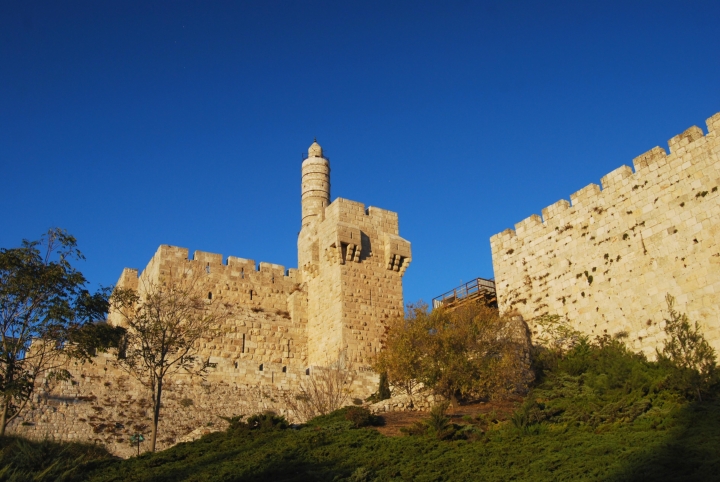
I entered the old city by way of Jaffa Gate. As I stood at the busy entrance, the Tower of David to my right and the start of the Bizarre straight ahead, I knew I needed to get my bearings, to choose my path. I stopped for coffee at a Christian cafe on the corner and looked through my travel app.
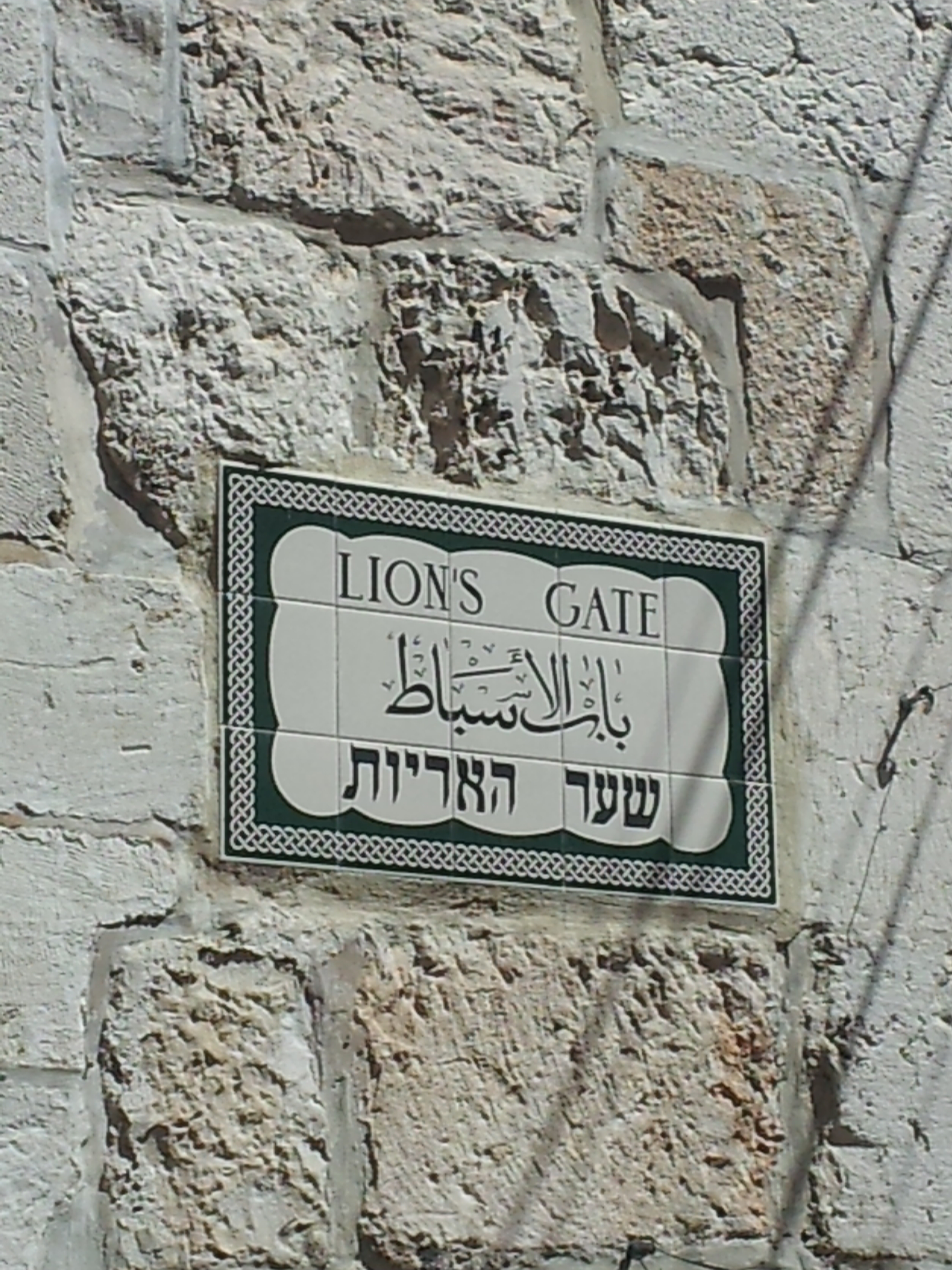
I wanted to walk the Via Dolorosa, the way of grief and it seemed appropriate to start my day there. It starts at the Lions Gate on the opposite side of the ancient city, so I made my way there through the narrow, crowded alleyways.
The Old City of Jerusalem was originally built in 1004 B.C.E. by Kind David, the man after God’s own heart, the boy of great faith and courage, the man of great shame and even greater honor. This city he built has been known as the center of the world. Ancient maps show three continents: Europe, Asia and Africa, situated in a circle with Jerusalem at the center. Since then Jerusalem has been cherished and glorified by Kings and conquerors. This is the land of my spiritual heritage.
The Via Dolorosa consists of 14 stations marking the path of Jesus during the last hours of his life. They are based on events that occurred along the way to Golgotha where He was crucified. I know the story well and yet as I look around me, I feel a tremor of expectation and foreboding.
It’s not as if I believe being in the land will bring me closer to God or that the location itself possesses a magical power, but I cannot deny this is having an impact beyond what I expected. Being able to see, touch, feel…to experience this journey – even with all of the changes brought by time – take it beyond a story or a vision on a screen. It removes some of the ideas and assumptions of common thought to add a true perspective, which personalizes it.
Station 1 is located on the north-west corner of the temple mount. This is the present position of the Al-Omariya school. In Roman times this was the place of the seat of Pontius Pilate, located in the Antonia fortress, and the place of the hall of judgment.
As I stand in the school yard and look into the plaza I imagine the crowds that day when Pilate asked who should be set free by popular acclaim that Passover day, as was custom.
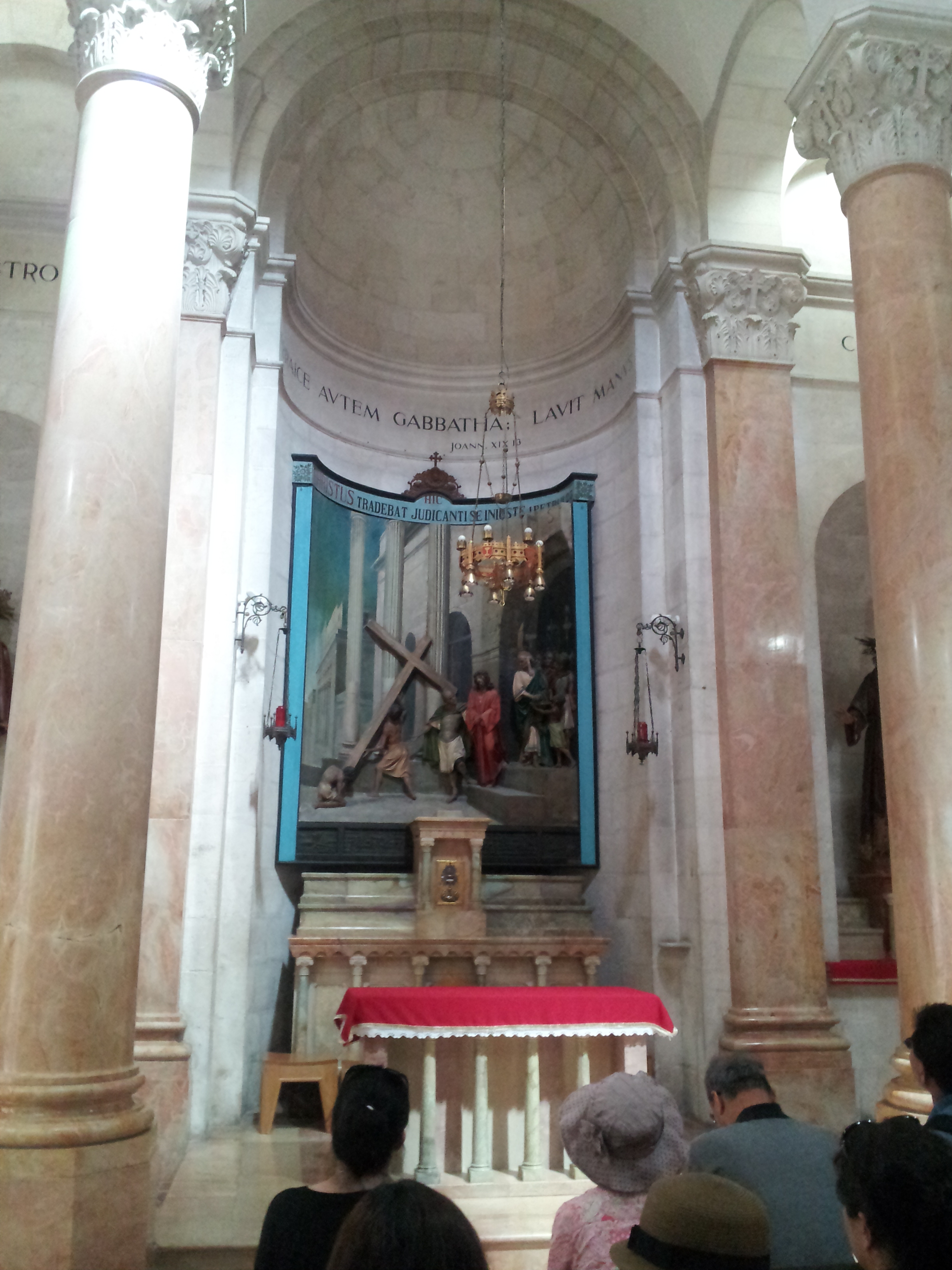
“Give us Barrabas,” they cried. And he was set free.
Jesus was condemned to death that day, and even Pilate knew there was something wrong with that choice. The Bible says he turned and washed his hands of the blood of this innocent man.
I’m not innocent; I have made many mistakes. But I do know the pain of being falsely accused, of being misunderstood, of being betrayed. The tears well in my eyes as I think of how I feel in my much lesser experience, how He must felt at the gravity of what He would face. I consider the sentence placed on him that was greater than any punishment I could ever know, greater than He deserved. And yet he was born for just this purpose, this horror. This was the final leg of his destiny on earth.
Station 2 is near the compound of the Franciscan monastery. This is where Jesus was beaten and where He received the cross.
There are two churches in the compound: The Flagellation and The Condemnation. The interior of the churches house remarkable stained-glass windows and statues that illustrate the events of the conviction, flogging, the soldiers placing a crown of thorns on his head, and the cross being placed on His back.
There’s a post in the plaza between the churches that is like the one Jesus would have been strapped to as the soldiers scourged him. The tour groups have dispersed and I stand alone in the plaza. In the silence I can almost hear the echoes of the mocking voices, the crack against His skin, His painful cries. I can imagine the blood that spattered the stones and the crowd that watched.
I sit down on the cobbled ground and weep as I quote the words I’ve carried with me as promise for so many years.
“He was wounded for our transgression, He was bruised for our iniquities; the chastisement of our peace was upon Him, and by His stripes we are healed.”

I’ve always been taught that Jesus bore our sins and our sickness. He took all my shame and pain for himself so that I could know freedom and peace, so that I could walk with confidence. I need that freedom today; I need to know that forgiveness. I am beaten and lost. I need to know that love now, more than ever.
I can hear my Mother whispering a song in my ear and I find myself singing in a soft, broken voice: “Amazing grace shall always be my song of praise for it was grace the bought my liberty. I do not know just why He came to love me so. He looked beyond my faults and saw my need.” How could anyone love so much to not only give their life, but endure so much to ensure I would have a way to peace and victory?
Station 3 is located on the corner of via Dolorosa and El Wad (Hagai) street. This is the place where Jesus fell for the first time beneath the weight of the cross. The image of this has been carved at the entrance of the Polish church built here.
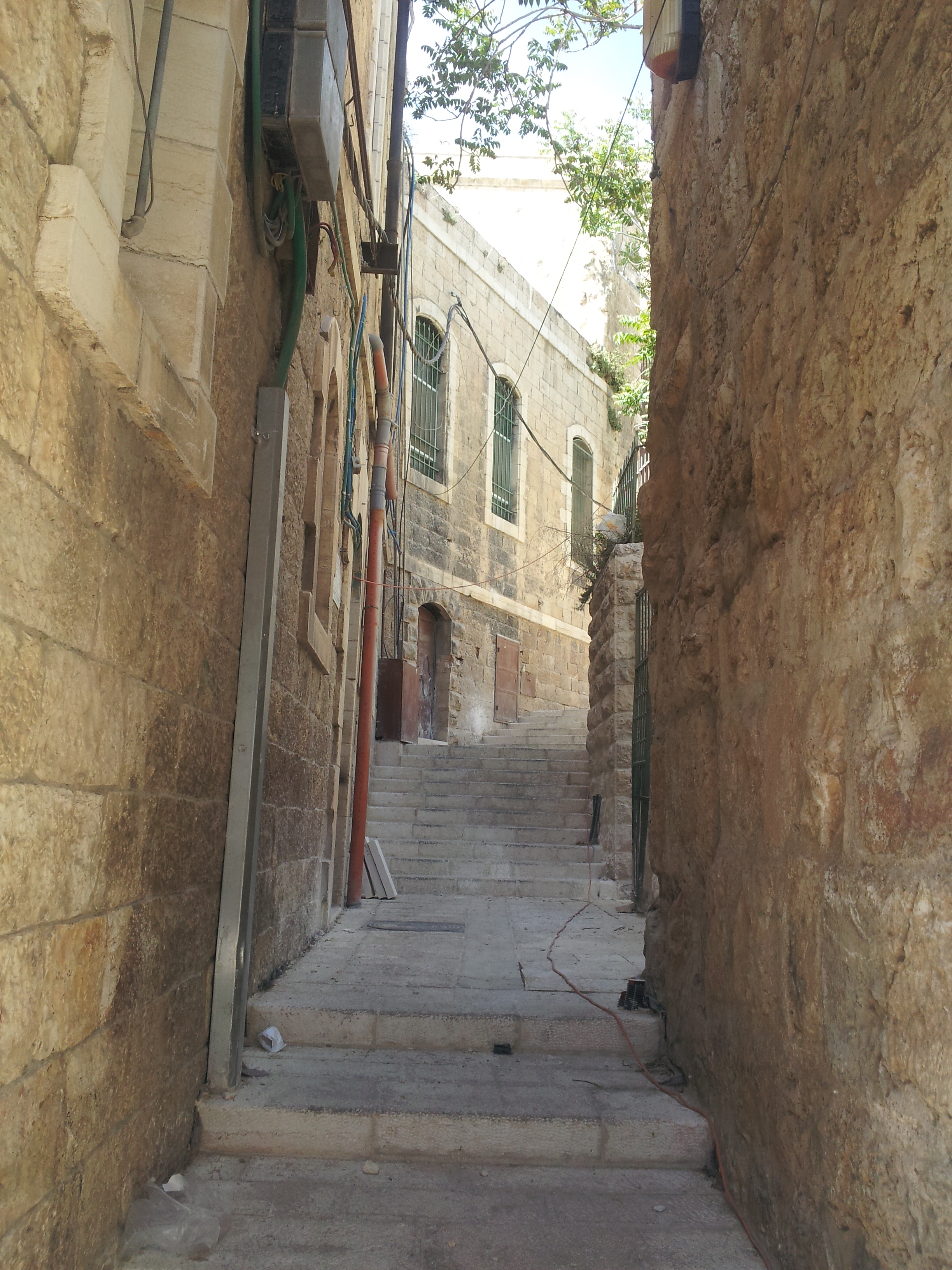
Station 4 is where Jesus met his mother, Mary. She would have come from the small alleyway, pushing her way through the crowds, desperate to catch a glimpse of her son, to have one last minute with Him. She was there with John: “When Jesus therefore saw his mother, and the disciple standing by, whom he loved, he saith unto his mother, Woman, behold thy son!” (John 19:26)
He was being humiliated and shamed, cruelly mocked and struggling to carry the weight of the cross, and yet He had the presence of mind and the selfless spirit to seek assurance His mother would be cared for when He was gone. It’s a staggering thought. I can hardly stop thinking about my own pain; I can’t block out the words that haunt me or forget the bitter experiences. But then I think of the past year, when nothing mattered but my Mother and her needs. Nothing I thought or felt was as important as easing her pain, lightening her load…ensuring she would have a future.
At Station 5, Simon helped Jesus carry the cross. I look up at the road that turns sharply to the right and climbs up the hill through a series of stairs. I lean against the corner wall and take a sip of water.
I’m carrying a small backpack and I’m feeling tired beneath the heat of the sun and the pressure of walking on the cobbled stones at a staggered incline as I weave through the streets. Jesus hadn’t eaten, was weary from the previous night of betrayal, emotionally drained from the trial and the continued mocking, physically exhausted from the beating and blood loss…
Station 6: Veronica wipes the face of Jesus. An act of unexpected kindness. How we all search for them in our time of need, when we feel forgotten and forsaken. A small Greek Catholic Chapel commemorates the moment.
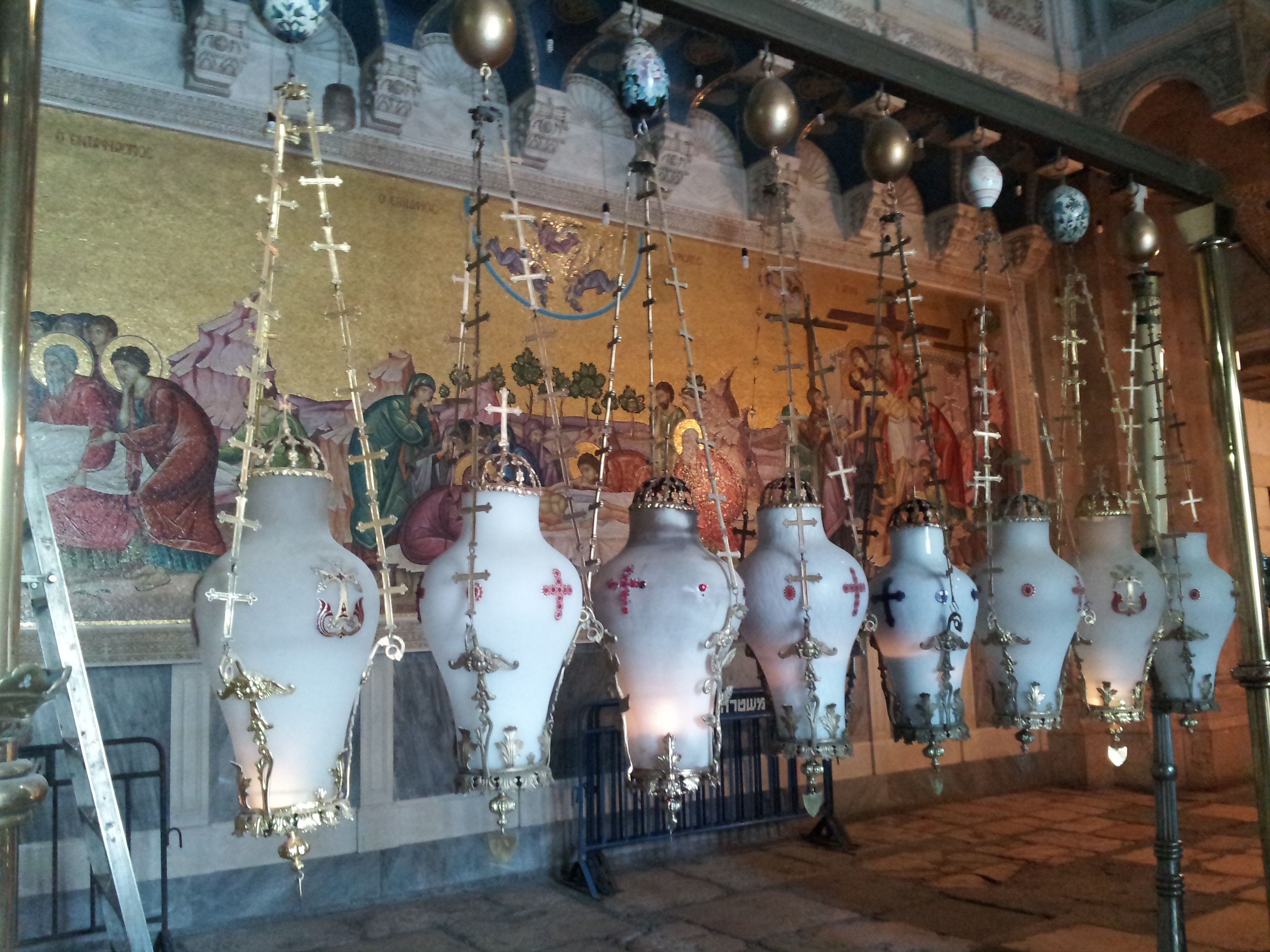
Station 7: Jesus falls the second time. This is where Jesus passed through the Gate of Judgment. This is one of the busiest streets in the Old City it would seem, and it may have been during this time of Jesus. It was an intersection of the Cardo Maximus and a traverse street of the roman Aelia-Capitolina; in modern days it’s the intersection of via Dolorosa with Khan es-Zeit (the Oil Market). The way up the hill and the pressure of the city does not make for an easy walk. Of course Jesus fell. I wonder if I will.
Station 8 is based on Luke 23:27: “But Jesus turning unto them said, Daughters of Jerusalem, weep not for me, but weep for yourselves, and for your children.”
And at Station 9, Jesus fell for the third time. This is near the Church of the Holy Sepulcher, on a roof courtyard above the underground Armenian Chapel of St Helen and at the entrance to the Ethiopian church of St. Michael.
By now he would have been beyond critical blood loss. His strength would have been gone, his vision blurred and eyes blocked by the blood trickling from His brow. He must have been so ready for the pain to end.
Stations 10 – 14: Jesus stripped of His garments, nailed to the cross, dying, being taken down from the cross and taken to the tomb are all marked within the walls of the Church of the Holy Sepulcher.
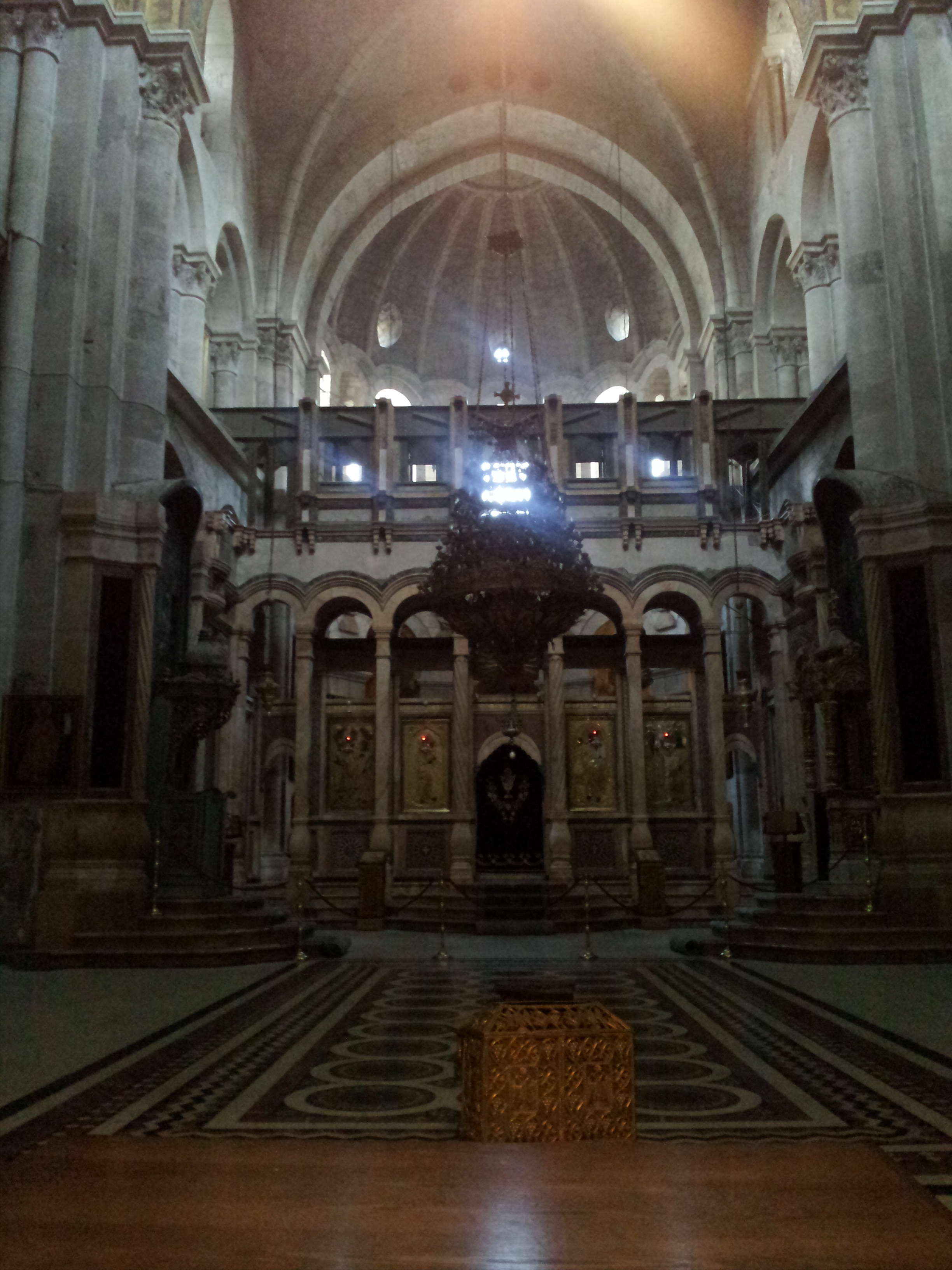
The first Church of the Holy Sepulchre was approached by a flight of steps from the Cardo, the main street of Jerusalem. It was accessed through a narthex, a basilica and an open area (the holy garden), which had in it the rock of Golgotha. About 10 years after the crucifixion, a wall was built that enclosed the area of the execution within the city and separated the image of the skull from the city. (I would see the image of the skull in the landscape that gave Golgotha its name later. It is just outside the walls, and although protected, the view is blocked by a modern bus station.)
The church has been destroyed, rebuilt, captured, adapted, liberated and renovated by various religious and political sects many times throughout history. The church is richly decorated with structures, art, ornamentation and symbolic relics that mark various phases of medieval history, European imitations and Christian history. You can visit the Armenian chapel deep below ground level, and explore the Edicule on the main floor. There are beautiful mosaics, icons and lanterns, part of the rituals and reflections of the passion of Christ. Upstairs are Greek Orthodox and Catholic alters that mark the crucifixion. In all, six denominations celebrate their rites in and around this cavernous house of worship.
The church is significant in understanding contemporary Christianity and its complex history; it is certainly a living testimony to the tenacity of Christians to retain and honor their own piece of Jerusalem. But somehow I feel the personal connection to the Passion experience is lost in the elaborate embellishment and rituals, in the tension required for the varying religious groups to maintain their presence and reflect their heritage. I am immersed in the beauty and culture around me, yet it doesn’t hold the power to move me, to capture my heart as simply walking the steps of Jesus did.
It’s hard not to consider how this may actually reflect the impact of structured religion on society today. What began as a celebration, a proclamation of the gospel, and even a means of discipleship and growth has become a relic of history, a testament to the past, but not a true path to finding a deep, abiding relationship with God.
Jesus came to love. He walked among us, showing kindness and forgiveness, offering grace and mercy. He gave honor and respect, and was only relentless in sharing the love of God, not the dogma of religion.
As I leave the darkened hall of the church and squint into the sunlight, I know without a doubt I’d rather be remembered for love than arrogance; I’d rather fight for the experience of a loving relationship, than go to war for a symbol of it. My journey today has led me to a personal truth: though I am still in the midst of my via dolorosa, it doesn’t feel as meaningless and cruel. I’d rather walk the way of grief than sit in a hall of history or an emblem of fame.

 by G. Anne Bassett
I can’t believe I’d not read this before. This was amazing and left me in tears. I am so happy you were able to be there and experience that….once in a lifetime amazing spiritual journey… xo