An Unfinished Life or A Life Undone?

Is there something in your life you want to do, but remains undone?

Well, of course.  Every good procrastinator can look around and see a ton of things left undone.  Anyone with a bit of ADHD can point out all of the unfinished projects littering their lives and reminding them of their propensity for distraction.  For that matter, anyone with a busy life will complain of things they just don’t have time to finish.  We are a people undone!

But, I wonder how many things in our life that remain undone are actually important in the big picture.

The room unpainted? The basement unfinished?  The leaky faucet that still drips?  These are temporary appeasements.  They will add comfort and satisfaction, or perhaps even make our current situation a little better, but they are not of much importance in our greater purpose.  These are simply the everyday reminders of imbalance.

Perhaps it would be something more along the lines of starting that business you’ve been thinking about, or writing that book you’ve been wanting to write.  Those are more lofty unmet goals that deserves a bit of mourning.  Yet, they don’t resonate with life-affirming importance, either.

What of the “bucket list,” those things we seek to do before we die?  Skydiving?  Sailing on the Mediterranean?  Hiking in the Amazon? A spiritual journey through the Holy Land? The grand adventures of experience and travel that line the pages of our mind.  These activities are fulfilling in their own right, but again, lack true emotional or spiritual significance in the big picture.  Our bucket lists are often a reflection of the selfishness conspicuously absent in the dying.

It’s not easy to think about what would matter if you were facing death.  I remember reading a book with my friends about living life as if you only had 30 days left to live.  It pointed out that perspective changes when you know your time is limited and it posed the question(s): what would you do?  What would you change? What would suddenly become meaningless and what more important?  The idea was to remember that we all have limited time on earth; we forget and/or take time for granted.  But if we were to start living life as if we were dying, wouldn’t we make decisions with more clarity? Move with less hesitancy? Approach each other with a more open heart?

It’s not a new idea; the self-help aisles of bookstores are lined with books reminding us to live each day to the fullest.  I found the discussions in our little group somewhat amusing given this particular book was not just a self-help guide, but a kind of spiritual counseling.  Instead of reinforcing church doctrines, it challenged them.  It seems for many of us, some of the rules and ideologies for living a Godly life wouldn’t be as important if death was knocking.  The freedom to embrace all that life has to offer in the limited time available would sometimes involve appreciating things that may be in direct contrast to religion, shedding the restrictions and walking in a very basic understanding of love, peace and simple joys.

You see, in the end, the things left undone in life that will matter, the things you will strive to repair or resolve, are the open issues of the heart.  It will be less about projects and tasks, or travel and exploration; it will not be about preaching and teaching, or arguing and debate. Who’s right and wrong won’t matter as much as the goodbye and the legacy of love left behind.

I think when asked what thing I want to do that remains undone, it’s not just a question of to-do lists or unrequited dreams.  It’s about addressing the disappointments and hurts, the failures and unfinished business that burden my heart above any physical, financial or mental limitation.

Harold Kushner once said “I am convinced that it is not the fear of death, of our lives ending, that haunts our sleep so much as the fear that as far as the world is concerned, we might as well never have lived.”  Our real legacy is rooted in relationship, in the memories and love of those left behind.

So I think of who needs to be forgiven? Who I need to ask for forgiveness?  Who needs to know I love them? I admire them?  Who needs to hear why they are special?  Whose life could I touch for the better with a simple act of kindness?

What are the things left undone that prevent you from living passionately and loving completely? It’s not what’s you didn’t do, or didn’t experience, or what’s missing from your life that is important.  It’s the “undone” in the life you currently live that really matters.

What is left undone that would result in a truly unfinished life if you don’t address it?

Maybe it’s time to take action.


When Bad Things Work For Good

The meeting invite was accepted the day before.  It appeared to be just another status meeting between the director and the project managers.  As I arrived to the office that Thursday morning, it quickly became apparent this would not be just another day at the office.  The air was thick with tension and I frowned at my friend and teammate who gestured to her cell phone: code for check your messages.

“Why cancel the meeting and then schedule one with me privately this afternoon unless I’m getting let go?”

I checked my emails and calendar.  The meeting had not been cancelled for me.

“It’s not you,” I typed the assurance.  “It’s me.”

This wasn’t my first lay-off.  I knew the trademark covert moves and deceptions of a corporate lay-off.  I knew the averted eyes and nervous try-to-act-normal moves.  My time was up.  She would be taking on my projects.

As I sat in the office with the Executive Director and a VP from corporate headquarters, I didn’t really hear the spiel. My boss was fidgeting and afraid, uncomfortable with this assignment and clearly quoting a script rather than speaking from the heart.  The VP was decisive and arrogant, ready to battle any argument or negative emotions with the weapons of corporate cliche.  I was just going through the motions.

I’d spent three years in a position supporting the company’s largest account, creating regular cash flow through operating projects and huge revenue from large capital projects with very little support from the organization.  I’d had to think outside of the box, create alliances, tap unknown resources and generally problem solve in the most creative way possible just to get the job done.  There was never a thank you or a hand offered to help, there was never any training or supports offered that would actually benefit this account.  All attention was based on their future direction without any concern for maintaining the account that would support building this new ideology.  It was always a battle. I had been miserable for quite some time.

“Good luck with your future,” I told them.  Of course I didn’t have any questions.   I knew the deal.  And why argue?  They’d made their decision.  Why fight it? Nothing would change their minds and they were following the letter of the law.  Why even question their logic and decision?  Anyone can be replaced and very likely will be at some point in life.  You can be the hardest working, most dedicated employee, but when it comes to financial decisions, corporate loyalties side with the numbers over individuals.

April 14, 2011.

I handed in my equipment, packed my things and left the office that day with a mixture of relief and fear, knowing  with a disturbing certainty this was going to be a difficult time, but feeling there was an inevitability to it all.  The economy was terrible and finding a job would not be easy; middle managers & directors were lined up at unemployment offices everywhere.   I understood on a personal level the mental and emotional challenges of being unemployed.  I had first hand experience with the prejudice and discrimination I would face.  Being trapped in the laid-off vortex that was the aftermath of 9/11 had opened my eyes to some harsh realities.  As I drove away, I sensed my course had just been altered far beyond the obvious job change.

Mother 001That same afternoon we discovered my Mother had obtained the MRSA infection from a standard knee replacement surgery.  I would spend the next thirteen months as her caregiver, watching an infection slowly destroy her body, but never her spirit.

Being stripped of security and shoved into the abyss of uncertainty is more than frightening.  It’s life altering.   Being placed on an epic path of insidious disease and loss is terrifying.  It’s life transforming.

I will never regret those final thirteen months I spent with my Mother.  She was my best friend.  She was my hero.  But it was more than just time: time to love, time to learn…time to say goodbye.  It was an epic journey of courage and faith, proof of the enduring strength of the human spirit and the undeniable truth of unfailing love.

Almost two years after my mother’s death, I have still not returned to the career that once had a part in defining me.  Do I miss the money?  Yes.  Do I miss the security of a regular paycheck? A resounding yes.  Do I have regrets?  Of course, but none of them involve working harder or smarter in the climb to the top of the corporate ladder.  I don’t miss that at all.

I have downsized my life.  I  have taken on a roommate; I live in a smaller space, buy less stuff, eat less fancy, and enjoy fewer perks/amenities.  I work with a non-profit that serves patients and caregivers, and take on odd jobs to supplement that income. But I have time.  Time to paint, and draw, and write.  Time to talk with the brokenhearted over coffee, or take a spontaneous road trip to help a friend.  I have time to volunteer, time to help the needy.  I have time to nurture patience and perform acts of kindness.  I have time to love.

The day I lost my job – and the sense of security we all seek and desire – was the day I found time.  With time, I find a better life.  With time, I find purpose.  With time, I find the real me.

Has anything bad ever happened to you that turned out to be for the best?

Who’s In Your Pod?

peasI like to give gifts.  I’m a gift-giver.  You know, one of those strange people who actually do find significant pleasure in giving.  Perhaps that makes my gift-giving a selfish act, which in itself negates the original intent, but that philosophical quagmire will be left for another post.  Or not.

Nevertheless, to me, gift-giving is a very personal thing.

I understand the reasoning behind gift cards and standardized presents.  If anything, I’m regularly reminded of the reasons behind these ideologies as a result of my gifts.  It doesn’t matter how much thought I put into a gift to personalize it for the individual, a memory or a relationship, it can always be distorted, maligned or just simply undermined by those pernicious character traits lurking in us all: jealousy, envy, narcissism, bitterness, ignorance, and all other insidious joy destroyers.  These are the storms of outside egos, the voices and emotions that muddy the waters of good intent and miss the obvious facts, and sometimes the universal truth.

This year I gave a gift to a friend.  She’s a domestic goddess of sorts, a chef in her own right and a Twitter aficionado.  That’s where I met her, on Twitter.  We formed an instant connection based on a common passion and similar humor, but it went beyond that.  Even after we met in person, that connection was undeniably authentic.  There was understanding without explanation,  acceptance without justification.  It was one of those relationships that just came easy.

The idea was to give her a pea pod ornament that would both mirror her foodie identity and celebrate her Twitter experience.  The problem: there were only nine peas in the pod.  Obviously I would not be able to fit all of her friends into the pod.  But then, the idea of a peas in a pod is not to include everyone.  The idiom itself is indicative of a special connection beyond fun, fandom and frivolity, right?  So of course I considered my friend, who she’d met in person, what I knew of her and with whom she most felt that invisible connection.  It doesn’t negate other friendships.  It doesn’t even downgrade them.  We all have relationships in our lives that serve varying purposes and have defining strengths.  You will never be in everyone’s pod anymore than everyone will be in yours.  This is truly a fact of life.

After much thought, I labeled the little peas in the pod with her nine Twitter friends.  They weren’t the same ones I would choose.  They weren’t the same I would choose for another friend, although I did make an exact duplicate for one friend, but it was based on a specific reason to her and her experience.  This was her pod, her gift.

You can guess how it all unfolded.  She was thrilled with the gift and the peas not on the pod felt shucked.

Although I think we all can understand the initial “why am I not on the pod” knee-jerk reaction, maturity and logic should be the sustaining thought.  The need to be included is as normal as breathing, but when dealing with hurt feelings surrounding a perceived exclusion it’s important to step outside of yourself and look at the bigger picture.

This got me thinking of relationships and the pod dynamic.

For the most part, pods are shared.  You know who would be in yours and you know you would be in there’s.  That’s the connection.  If you’ve ever thought, “I wish I knew them better” or “I don’t really understand them” or if you don’t really miss them on a gut-wrenching level when they are absent from your days, you probably don’t share a pod.  You may like the person, you may like the idea of being included in their pod, you may even be trying to form the bond that would create a gravitational pod pull.  But if you don’t organically feel that abiding connection, it’s not your pod.

We are all pod people.  Traditionally, we are a part of several pods from different areas of life: a family pod, school pod, work pod, online pod, fan pod, etc. Sometimes we try to blend our peas, to unite them in one big pod.  The illusion of success can be seen at parties and social events, in times of tragedy and need, but pea pods a rarely fully integrated.  They are linked by an indefinable soul source.

There are also times we longingly look at pods and feel the cold from the outside looking in…all the while, surrounded by the warmth of our own pod.   One of the saddest things we do as humans is ignore the peas in our pod while seeking inclusion in another pod.

I’ve been thinking about my pod(s).   Who are my peas?  Who are the friends I connect with beyond a shared universe, or even a shared orbit, and into a shared living atmosphere?   Who are the friends I don’t have to work and struggle to connect with?   The friends with whom I share a “knowing” that doesn’t really make sense to anyone but us?

Everyone in my life has a significance, a special place and purpose.  We share a story, a lesson, an adventure.  We share a relationship experience that matters to me.  But the truth is, I wouldn’t be who I am without my peas and the safety of that pod.  I’m glad I have them.  I’m glad you have yours.

Who would be the nine peas in your pod?  Stop a minute and give them a hug.

Thinking about one battle in the war on poverty

They’re at it again.  Our politicians are arguing over the war on poverty, or rather what causes the failure of this war on poverty.  They call it the downside to the recovering economy: the rich get richer and the poor get poorer.  Economic inequality is the downside of any economy.  It’s just felt more during a recovery because the “new” poor don’t recover as fast, if at all.  They haven’t grown accustomed to navigating a broken system and enduring the inevitable prejudice.

The parties agree we have a problem, but where the Republicans feel we cannot extend employment/welfare benefits and further increase the national deficit, the Democrats believe unemployment insurance actually helps the economy and therefore reduces the deficit in the long run.  This is the same old argument.

You know that old saying about the definition of insanity: doing the same thing over and over against but expecting different results.

Why can’t our leaders begin to think outside of the box? Better yet, why don’t they get out of the rich seat of clueless patronization and work with the poor to find a solution? Perhaps even try to break it down a little more like the average American, or foreigner for that matter?

Unemployment is an issue.   We have standard unemployment insurance guidelines that work during a healthy economy, but seem to fail during a depression and the recovery that follows.  Why?  The length of unemployment extends beyond the standard timeline.  That seems to be understood since the usual response is to provide benefit extension (additional 16 or 21 weeks) in tiers based on the unemployment level in each state at the time.  So the problem is understood, but the standard response to that problem – unemployment extensions – are not working and further strain the budget.

Here’s something else that’s common knowledge and proven through research.  The long-term unemployed, defined as anyone who had been out of work for greater  than 6 months, face discrimination in the workplace.   Experience and skill level takes a back seat to that timeline of joblessness and the stigma it carries.  So, at a time when unemployment benefits are set to expire, it becomes exponentially more difficult to gain employment.

The traditional answer, to extend benefits, addresses the need for money to survive, but doesn’t address the root of the problem: joblessness.  Job growth initiatives address the overall numbers (e.g. this many new jobs = this many off unemployment docket).  Yet that doesn’t appear to be impacting the social program dollars as much as the reporting numbers themselves.  Why?

Just a thought.  New jobs go to newly unemployeed.  The long-term unemployeed remain in the system, and begin accessing other programs the longer they are jobless.  They also cease to be strong contributors to the overall economy.  It’s logical really.  The person who is recently unemployeed is using the funds of a working system, the standard unemployment measures.  They haven’t started tapping into their savings to survive (yet), haven’t fallen short on payments (yet), haven’t downsized (yet) and aren’t living on a shoe string budget (yet).  It’s the long-term unemployeed, those surviving on the benefit extension programs while facing all of these additional burdens, that start signing up for food stamps and other subsidies.  The long-term employment issue is a larger problem than the actual unemployment percentage.

So here’s a thought.  Why not offer incentives to companies who will hire the long-term unemployeed?  Why not help break the discrimination that is such a handicap before benefit extensions and other government subsidies are required?

Why not offer incentives to partner with their state department of labor to a greater level?  Instead of using it as just another posting board, use the department as an interactive recruiting and development forum?

Why not upgrade the set-up of the department of labor so it actually is functional and not preaching impossibilities instead of teaching how to overcome the reality?

How about incentives to corporations that provide grants to be issued through the department of labor to train long-term unemployeed on jobs specific to their business?   Or perhaps a program that provides priority treatment to the unemployeed who spend volunteer during their difficult time?

Why not actually start an education campaign – something real and felt, that touches the heart and opens the mind –  so we (and I’m including the President of the United States here) are not always reminding the policy makers that the unemployeed are not lazy?

Wait, why not create a War on Poverty initiative that actually involved the impoverished in the research, studies, policy and procedure creation and in building a new infrastructure?

Just as you can’t bring about change by making the same failing moves over and over and over again, you can’t manufacture a solution for poverty from the rich seats far from the problem, separated by a clouded, glass dome of delusions, lies and misinformation.

Unemployment isn’t the only issue.  Lord knows we’ve got a myriad of misconceptions and missteps to correct, and a stagnant system to completely revamp, but as our political leaders are pecking away at these problems can they at least try to approach it from a different side of the coo coo nest?  America would appreciate it.

Do you have creative ideas for turning the tide on the battle of unemployment in this war on poverty?

120 Years of Torture And Now This

We were on a road trip, driving through the night on our way to Georgia from Pennsylvania, when my friend poured out her heart, sharing her childhood woes and the abuse she’d endured: primarily, the dreaded Olive Loaf.  For those of  you who are not aware of this torture tactic used by parents to support Oscar Meyer, the Olive Loaf is a lunch meat identified as mechanically separated chicken with propionate & benzoate, olives, pimentos and various ingredients designed to preserve that which should not be preserved.

Oscar Mayer Olive Loaf  Image

This lunch meat has been on the market for 120 and yet most of us wonder how.  My friend doesn’t just wonder; she is tortured by the memory of sack lunches and picnics in the park.

Ironically, this lunch meat is one of the most donated items at food banks and non-profit shelters.  Is this kindness or cruelty?  It’s hard to say since even the hungry seem to pass on this particular delicacy.  Tonight, I sought to re-purpose this meat, to transform the dreaded Olive Loaf from torture to a taste sensation.  It would require creativity, ingenuity and superhuman powers.

I didn’t give myself time to reconsider this project, but jumped into the task with the speed of a Food Network Chopped Champion.  Tearing open the package, I ignored the individual slices, pulled it out as a block and diced it.  I sauteed it in a pan of garlic and onions, sprinkled with red pepper chipotle seasoning.

A quick pie crust was spread across a pan and the bottom brushed with a barbeque and salsa mixture.  After sprinkling a layer of shredded parmesan & romano cheese, I added a layer of mixed vegetables followed by a layer of the sauteed meat.  I then sprinkled the top with goat cheese crumbles and poured a mix of 4 eggs beaten with 1/4 cup of cream.  A pinch of salt, pepper and parsley on top for seasoning, and this experiment was ready to cook (350 degrees).

About 30-40 minutes later ….

The taste testers – or victims depending on the results – lined up to be served. There were no screams or cries for freedom; I was not attacked by an angry mob of processed meat vigilantes.  Instead, they thanked me and asked for seconds, oblivious to the hidden evil of this savory pie.

Tonight, for a short fifteen minutes, Oscar Meyer was redeemed when his Olive Loaf took center stage and people lived to tell about it.  Tonight, I was wonder woman and it felt good.

Selah!

A Day of Results

It’s an infection.

Those words should bring relief. 

There’s an anomaly in the culture.

The blood drains from my face.

I am not afraid of cancer.  It doesn’t run in my family.  I don’t smoke.  I eat better than most Americans and exercise regularly.  The standard indicators and markers don’t loom over me, threatening to initiate an attack at any moment.

You’re going to be okay.

That’s what they told my mother. 

I watched as an infection slowly destroyed her.  It would only reveal itself after extensive damage had been done.  They would clear it from her system, tell her she’d be fine, and then it would appear again in another part of her body, decimating yet another organ. It was an unrelenting enemy, hiding in the cellular trenches, camouflaged by the medications meant to destroy it.  The infection was a black ops batallion, landing, destroying, conquering. 

My mother is dead.  Infections scare me.

I feel numb, and alone.  There’s only a few people I would talk to about this.  I can’t reach out to them.

The Hospitality House calls. There’s a guest who needs to check-in.  It’s work.  A distraction.

He’s from Chicago.  He has salt and pepper hair, kind eyes…and cancer.  As I show him around the house, we talk of history, architecture and design elements.  He stands aside and watches as three other guests excitedly surround me.  They tell me they want to cook me dinner, or rather dinner for the house.  They want to prove they can cook too.  Mostly, they just want to thank me for making them laugh so much the night before. I know they just want to feel normal again.  When you’re facing sickness and loss, being viewed as more than the the tragedy becomes the greatest gift you can receive.

Tonight we’re having soul food.

He explains he has an appointment at 3 pm followed by a seminar his doctor is conducting.  He won’t be back for dinner.  I wish him luck.  He’ll be at the Hospitality House for several weeks.  I tell him to consider it his home away from home.

We have several people check-in.  The house will be close to capacity tonight.  It’s good. I’m busy.

A friend pays a surprise visit. We laugh and joke. I don’t want to break the mood. I don’t want to step outside of this strange and fragile bubble. I don’t want to think about it.

As dinner is called, one of the chefs pull me aside.

“You didn’t tell me we’d be cooking for white people.”

“What?”

“White people won’t like our soul food.”

I couldn’t stop the grin.  “Am I not white?”

He looked puzzled and then laughed. 

“No,” he said.  “You’re family.”

As we all gathered around the table, eating barbeque, corn bread, chili, sweet potato souffle & peas, it felt like a family reunion.

Laughter is healing.

I am going over the books with my co-worker.  My shift is ending; I’ll be off for a few days.

He steps through the door and introduces himself to my partner.  He carries himself with the dignity of a king and the gentleness of a nurturing spirit.

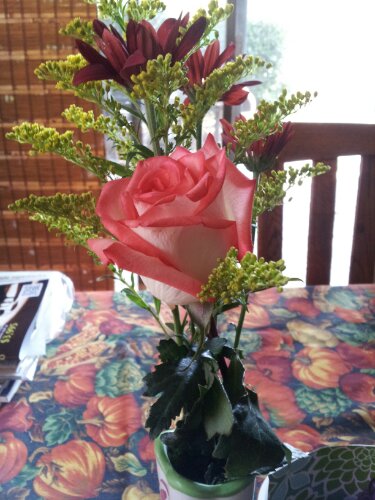
He hands me a rose.

I haven’t had a man give me flowers since I was in France trying to break the bonds of confused American modesty to embrace French freedom.  A topless me deserved a bouquet.  I’m not sure why I deserve this beautiful flower tonight. 

image

“For me?”

“Yes,” he smiled and added.  “There’s more to come.”

Men facing death are not too intimidated to show their interest.  It’s a double-edged sword. 

We talked about his appointment and his treatment plan.

I told him about my test results…and my mother.

“It’s just an infection,” I finally said.

He takes my hand.

“Yeah,” he murmurs and looks into the distance.  “It’s just cancer.”

I understand.

Shame

I volunteer at a local Hospitality House, a non-profit organization dedicated to providing a “home away from home” to outpatients and caregivers of patients at surrounding hospitals.  One of our guests is the wife of a quadruple bipass heart patient, a federal employee who is only one day out of surgery.  Today they were informed his medical leave was now considered “furlough” as a result of the government shut down.

She spent hours on the phone trying to ascertain when benefits would actually be cut off and how to pay his insurance premium out of her own pocket since without insurance, they would be facing a hospital bill nearing a quarter of a million dollars.  He spent time stressed over the future instead of focused on his recovery.

The local congressman must have found the shut down an opportunity to gain footing with his constituents because he sent out an email exclaiming “look what’s happened.”  She quickly fired off an email stating “we don’t have to see it, we FEEL it and you ALL should be ashamed!”

And they should!  Sadly, The real shame is that our “representatives” have no shame or they would be working harder to ensure the weak and wounded aren’t left out in the cold during a government shutdown that still somehow manages to pad their pockets. But hey, they reopened the national parks…clearly there are priorities.