

Detours And Shared Journeys

I took a detour.

It wasn’t on the original plan.  I don’t always follow the plan.  Plans are meant to be guides, not limits.  My first trip overseas taught me the best plans open doors to new experiences and exciting memories.  They should never restrict you to checklists and guidebooks.  So when the GPS said the quickest route home would be the highway, I ignored it and turned toward the more scenic route.  The road less traveled…metaphorically speaking, of course.

It’s called the Cape Hatteras National Seashore.  It is the scenic road (NC 12) that connects the barrier islands from Bodie Island to Ocracoke Island over about a 70 miles stretch. It’s the Great Ocean Road of Southeastern America.  It by no means matches the greatness of the Australian wonder, but every country possesses its own magic.  Sometimes Americans overlook and often take for granted the beauty of our land.

Cape Hatteras is a combination of natural and cultural resources, and during peak season a cornucopia of recreational activities.  Fishing and surfing along this coast is considered the best along the east coast region.  Combined with off-road vehicle adventures, kite boarding, sailing, jet-skiing, swimming, and the plethora of water activities available, this area is a much sought after vacation spot.

It’s winter now.  The beaches are empty.  The local fishermen can be found along the outer banks and in the marshes, but for the most part it’s miles and miles of unobstructed peace.
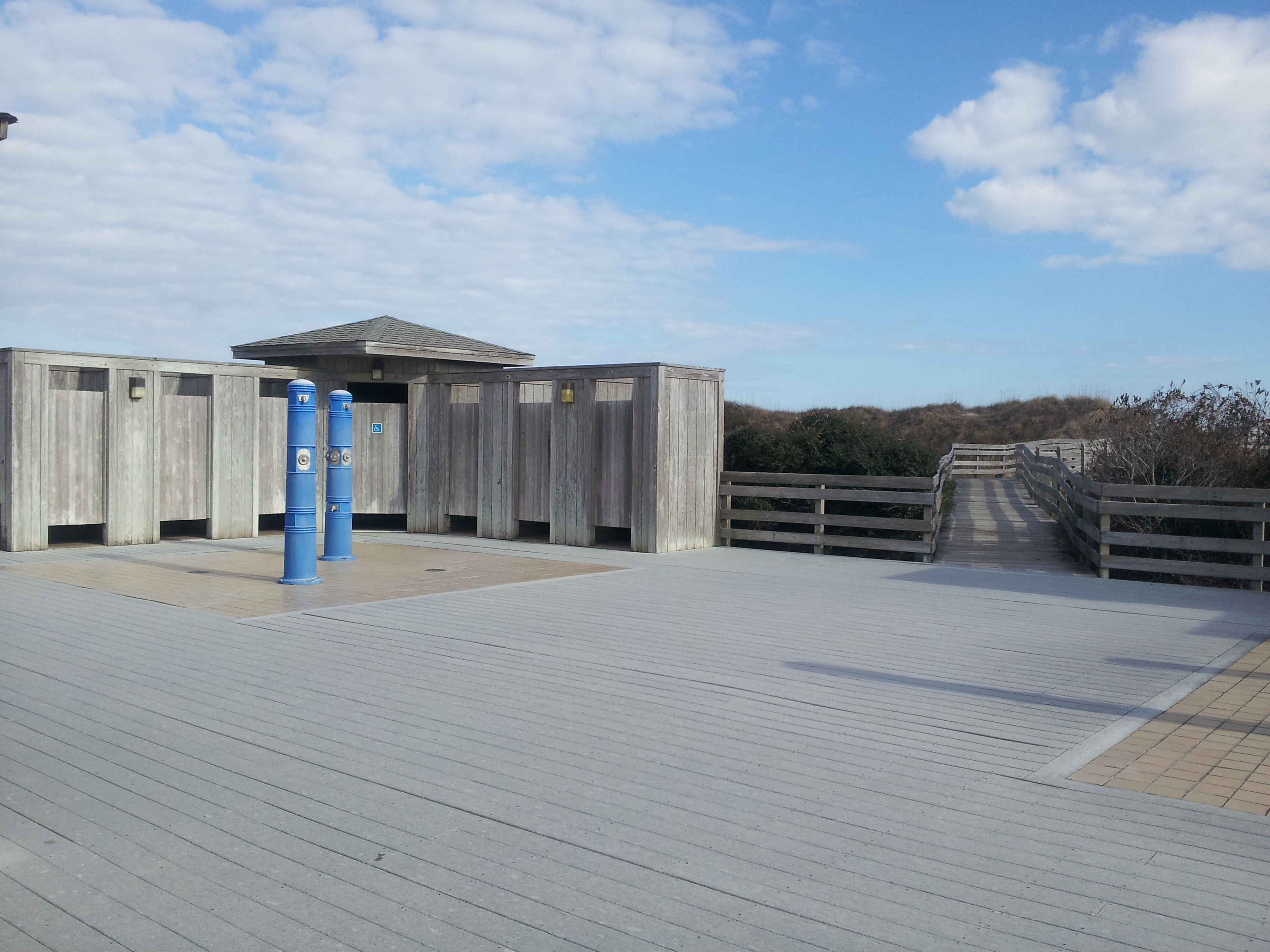
2013-01-08 10.29.25I stopped at one of the beach access points for a break.  It was a perfect place to take a picture of the showers and changing rooms available for beach dwellers.  I sent it off to my French friend who had mocked American modesty and introduced me to changing clothes on the beach.

“Now this is where you change into a suit!” I tagged the photo.

She reminded me that changing rooms are for sissies.

I chuckled.  I do miss France.

The walk on the beach was cold, windy and beautiful.  Storm clouds brewed in the distance and the sunbeams were bursting through the clouds as if creating a religious experience. How can you not take a moment to breathe it in? Let the beat of the waves adjust your internal rhythm?  Find perspective in the very existence of an ocean so deep and wide?

It’s easy to lose yourself in the stress of life.  Work-life balance is always an issue, but removing work from the equation doesn’t always equal life.  Often, the unemployed are too stressed about the future to actually take time to live.  How will I pay the bills? What if I lose my home?  My car? The fear for the future takes over and they are either overcome with a paralyzing depression, an unfocused anxiety or an obsession for the job search.  It’s one of those tragic points in life when excuses gain enough weight to appear as truths.

Sometimes looking out over the ocean reminds me that nothing is impossible.

I could walk on the beach for hours, but I should be on my way.  Pea island is only a few miles up the road and I hear it has a wildlife refuge.  Maybe I can drink my coffee with migrating fowls and seas turtles.

But wait!  There’s a lighthouse.

I pull the car to the side of the road and climb on the roof of the car to get a good picture.

A man is standing nearby wearing waders and chewing tobacco as he patiently awaits the tug on his fishing line.  He laughs at me.

“She’s perty, ain’t she?” Ah the extreme southern accent!  I mock my own, but try to behave with those who have it worse.

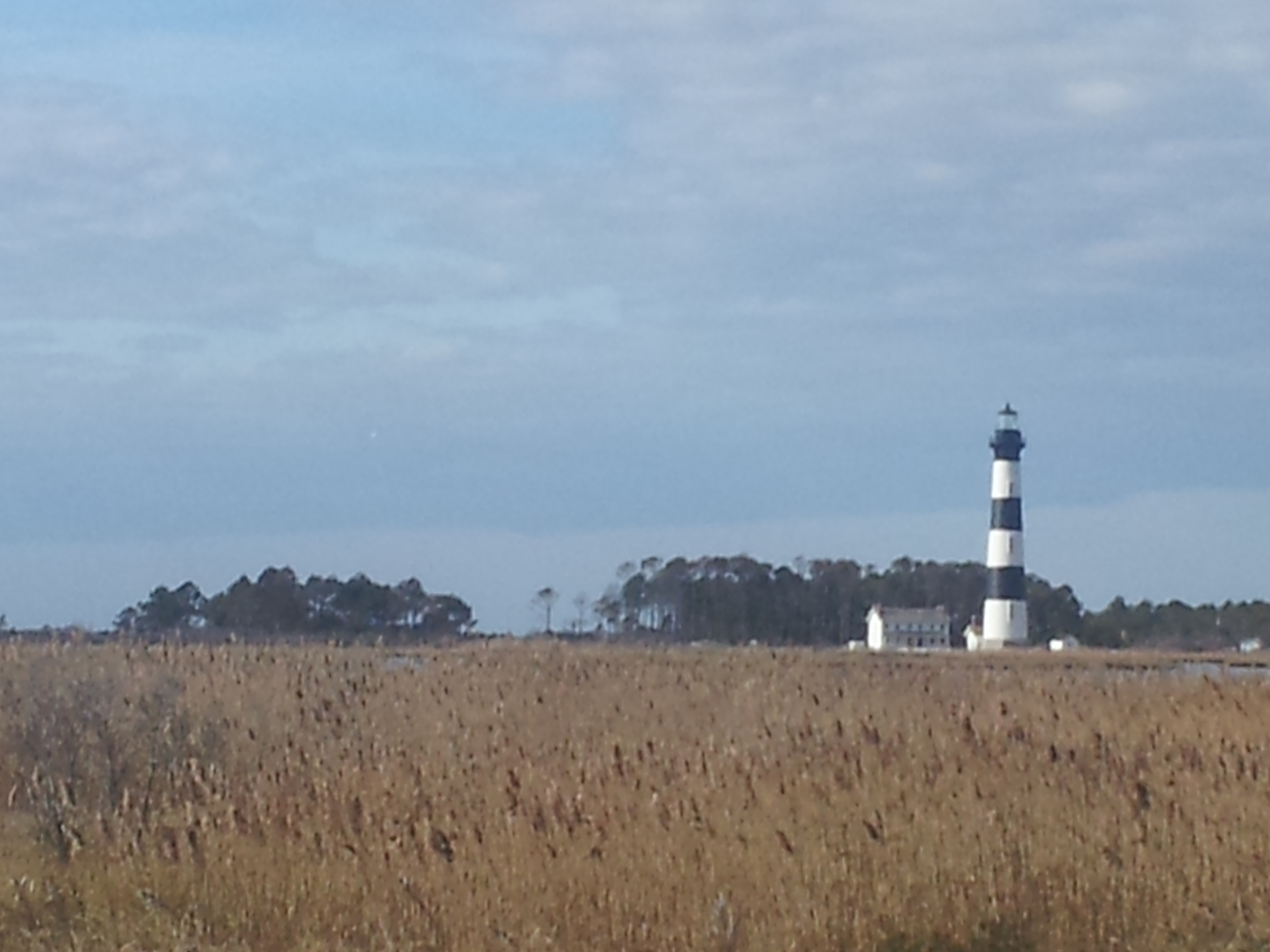
I discovered his name was Roger, and he explained the Bodie Island Lighthouse is actually the thirst attempt to illuminate the dangerous stretch of coast between Cape Hatteras and Currituck Beach.
2013-01-08 10.46.53
Bodie Island Lighthouse, North Carolina

“The keeper’s cottage has a visitor center,” he explained.  “I don’t know if it’s open since this time of year we depend on volunteers to run most everything.  You could try, M’am.  It has a good amount of history if you’re into it.”

Sadly, it was closed.  But there was a chatty groundskeeper who told me quite a bit about the structural issues with the lighthouse and the funding problems over the years that prevented proper historical preservation.  He also shared some folklore regarding the “Graveyard of the Atlantic.”  The treacherous currents, shoals and storms along this coast have provided a wealth of history relating to shipwrecks, lighthouses, heroes and ghosts.  You can only really appreciate these stories as delivered by the locals.

By the time I had walked along the path of the wildlife refuge and taken advantage of the many photo opportunities along the way, I realized I’d better stay focused or I’d miss the ferries that would take me back to the mainland.  There are two of them.  The Ocracoke Ferry is only a 30 minute ride (though the wait at the start can take some time).  The second ferry however is over 2 hours long.

After taking some pictures and tweeting with my friends, I grabbed my coffee from the car and curled up on the floor of the ferry beside a biker who was snuggled beneath his sleeping bag reading a book.  He was traveling cross country.  He’d been laid off and was heading back to his hometown in Arizona.  There was every reason to panic, to focus on the down side, to say he may have the time but not the money to take the time to enjoy the view.  He hadn’t.  When life had dealt him the blow, he’d decided to sell his house and make the cross country trip home a life experience.  He’d decided to let the future take care of itself.  He’d planned for the future and it was stripped from him with the cut of a corporate budget. Perhaps it was time for a new outlook, a new adventure. He may never get the time to do this again.

“Besides,” he said.  “Is it really that healthy to live in fear?”

I like him immediately.

My 10 hour drive home was entering its second day.  I wasn’t going to worry. I could send out resumes from home, or from the road. I could stress over my situation in the confines of my town, or I could seek peace and direction in this detour.

“I’ll share a section of my sleeping bag if you share some of that coffee,” he offered.

I did more than that.  For the next hour, I shared a journey.

Cape Henry Lighthouse or The Brig

Cape Henry Lighthouses, Virginia Beach

I stop for Lighthouses.

It’s an homage to my mother and a strangely appealing step in the mourning process.  More importantly, it has shed some light into the dark recessess of a wandering soul, specifically revealing the metaphor “I am a lighthouse.”

There’s a certain lore surrounding Lighthouses:  the remote tower of strength, lighting the way, directing boats through perilous waters, and guiding the lost through the storm.  And then there’s the mythos of the lonely lighthouse keeper, cut off from the world, faithful to a greater cause than self. Through my lighthouse journeys these past few months, I have found myself relating to this image more than I would like, and yet less troubled by the notion with the passing of time.  I can appreciate the ironies

My journey home from Baltimore sent me along the eastern coast, where many lighthouses remain as both historical monuments and functional forms of navigation.

Naturally, I stopped.

It’s not uncommon to find a lighthouse on a military base.  As the lighthouse protects the seafaring traveler from dangers and hazards so they may find safe passage, the military guards that same harbor to prevent dangers from passing the borders.  My stop at the Cape Henry Lighthouse brought me to the gates of the Fort Story Army base.

Now, I’ve been on military bases before so I was prepared for the usual protocols.  Unfortunately I forgot the most important rule: Don’t do anything until they tell you.

They search your car at the gate.  I was prepared and ready…and moved too soon.  I opened my door while the soldier was still looking at my paperwork. He went for his gun.

What???

I froze, of course.  I must have looked like a deer facing the headlights because he smiled, though he remained tense and alert.

“I moved too soon,” I said the obvious.

“You’ve done this before.” He speaks the obvious too.  “Generally you’re not supposed to get out the car until I tell you.  I need to ascertain if you’re a danger.”

I can understand that, but now I’m nervous.  When I’m nervous I go for humor or sass.  With a good-looking soldier, I go for both apparently.

“Did you want to search me?”

He stared at me blankly.

“I figured,” I instantly responded.  “I’m generally not that lucky.”

He grinned.

“I’m here to see the lighthouse.” See, I am capable of regaining my composure.

“You’ve been on base before?” He asked.

“Not on this one,” I answered.  “I’ve been on other bases so I understood the process – thought I’d get out of the car and move things along.  Good to know my moves bring out the guns.”

He laughed.  It was a real laugh from deep within that transformed the hardened features of this very disciplined soldier.

“I’m going to let you get out of the car,” he said, and instructed me to open all of the car doors, the hatch and the hood.  I followed instructions well.

“You can close them,” he said from behind me. What? I only just finished!

“You already checked me out?”

“Oh, yes,” he grinned.  “I followed your every move.”

Now I laughed.  He was cute.  What was I here for again?

He gave me directions to the lighthouse explaining I shouldn’t go beyond the flashing lights.

“If you pass them, you’ve gone too far and you’ll enter a restricted area,” he leaned toward me.  “Then I will have to search you and put you in the brig.”

“You say the nicest things,” I teased, dramatically fluttering my eye lashes.

He grinned.  “And you have made my day.”

Traffic was building up behind me, so I couldn’t stay.  It was a sad moment for me.  But I pushed forward and found the lighthouse.  Only, there were two of them!

The original was manned by the historical society. It was made of aquia creek sandstone, the same bricks that make up the White House.  A little history revealed the top of the lighthouse was blown off during a hurricane in the 1950s.  It was rebuilt and in 1964 became a historical preservation landmark.  I walked the spiral staircase to the top of the 90 foot structure and enjoyed the view.  Specifically the shore and the new lighthouse across the way.

The new lighthouse is cast iron and wrought iron construction, and stands 157 feet tall.  It is an active lighthouse, fully automated and not open for public tours.  It does make for beautiful photos, especially from the adjacent memorial garden leading up to the beach.

The restrictions of the base is limiting for tourists – it’s not as if you can hang out on the beach and enjoy water sports – but this is an enjoyable short excursion in Virginia Beach. For lighthouse enthusiasts or history buffs, it’s a must see.  For others, it’s a nice detour if you’re bored.  For single women or gay men, it’s anticlimactic after the gate search.

As I left, I waved to the soldier.

“You didn’t pass the flashing lights,” he called out. “I’m impressed.”

“We could always pretend I did,” I said.  “Your brig or mine?”

I may not be a lighthouse after all.

Baltimore: Where There’s Beauty In The Ugly

Baltimore is one of the ugliest cities in America according to Travel & Leisure magazine.

What do they know?  As it turns out…

It’s not just tourists or so-called experts making this judgment, but the residents as well.

I’m on my way to meet an online friend.  This will be our first face-to-face meeting, although I feel like I’ve known her for years.  I do wonder how she will unveil this ugly city.  What will she have to say about the town she embraces?

It has been my experience as I’ve been on my quest this past year that people like to show off the best part of their homeland.  They acknowledge the good, the bad and the ugly with a flip of the wrist as they move on to the good stuff.  In an area that is scoring low in every area of significance, what will be the focus?  What is the “good stuff”?

As I drove through the city, I have to agree the skyline, cleanliness and overall first impression of Baltimore isn’t anything to rave about.  But I was meeting her near the waterfront.  It’s hard to go wrong at a harbor, especially when there is an obvious effort to revitalize the district with a melding of history and modern influences.

The cobblestone streets and old-world architecture of Fell’s Point is balanced with hipster bars, trendy shops, local artisan galleries and upscale restaurants.  But what you really want to know is that this area boasts the largest concentration of bars and pubs in the city.  Well, that and the fact the area is rich with a varied ethnic population adding a much needed flavor to the business district that has a presence along the periphery.  It would be the perfect place to film a network drama.  Wait…It was the central location for Homicide: Life on the Streets in the 90s.

We didn’t spend much time touring the city.  Instead, my focus was directed to important elements of life in Baltimore.  One, Baltimore is made of neighborhoods, each with their own focus, feel and flavor, and two, it’s Small-timore.  Everyone resident seems to have there own 6-degrees to Kevin Bacon going for them.  This was important to learn since I was about to find out what makes Baltimore special…besides Michael Phelps…and the Ravens.

The neighborhoods of Baltimore may be be identified by architectural styles or economic standing, but they are mostly defined by the common interests and values of the residents.  The people are exceedingly welcoming and friendly in Baltimore.   They love to rave about each other, about their lives, their art, their interests, and yes, their loves.  And they are radical Raven fans.  The city is one big party after a game.

As I sat around tables, drinking coffee from handmade pottery in a room of professors, doctors, artists, journalists and accountants, all erudite hipsters enjoying life, or in a a hole-in-the-wall restaurant with local chefs and food critics, I understood the draw of the city.  It is a beauty beyond monuments, museums and tourist sites.  It is the heart of the city.  The people.

I often tease my friend – a magazine editor who once featured their Baltimore Olympic Athlete with a couple of Blue Crabs on the cover photo – that she would one day be able to say she gave Michael Phelps crabs.  I didn’t get crabs.  I didn’t get to be on the cover of a magazine either.  What I did get was a great welcome into the arms of a beautiful ugly city.

Perhaps Travel & Leisure should put down the polls and have a beer with the people.  Then they’d find the beauty of Baltimore…and maybe get crabs.