I should probably explain my friend is in amazing shape. She’s athletic and toned with a physical strength beyond the appearance of her slight frame. I, on the other hand, am an overweight American, an adventurous nomad trapped in the folds of Jabba the Hutt. Okay, that’s a bit extreme, but I’d be lying if I said I wasn’t a bit nervous that I won’t make it through the class and will walk away, head bowed in shame and humiliation, as the class moves into burpees. (I give myself credit for knowing that term, by the way.) I’m also excited because I’m going to get the unique opportunity to truly be a part of my friend’s life, her day-to-day experience. The fact that it may help guide me in my quest to get in shape is just a cherry on top…I’m thinking food at a time like this!! *sigh*
The Gym is One Size, founded November 15, 2012 by one of the trainers well known for her role on Laredet Begadol (לרדת בגדול), Israel’s version of The Biggest Loser. She led the class today.
She didn’t flinch or suggest I try a beginner class. That was encouraging! She did however explain to the class she would be repeating her instructions in English because an American was joining the class, not because she was showing off her mad linguistic skills. I liked her immediately. She was fun. She also worked us out for a non-stop fifty minutes. Jumping jacks, sit-ups, push-ups, planks with weight transfers, mountain climbers…and that was just to get our heart rates up I think! Then the TRX bands, which I’ve never used. No way could I do the suspension exercises, but I got a quick lesson on using them in a beginner capacity. The fact I liked it was both bizarre and thrilling.
I looked over at my friend moving like Xena, performing these exercises with ease and perfection. (I’d post a picture, but then I’d have to kill you…if she didn’t kill me first.) I thought I’d stick my tongue out at her like a jealous child, but I didn’t have the energy. It required all my strength to inhale.
I left the class sweaty, exhausted and in need of a shower. I’m not sure my friend broke a sweat. Not that I’m comparing myself with her. She’s been doing this for years, pushing her body with daily workouts that I couldn’t imagine. I’m ready to pin a medal on my t-shirt for completing the class without calling emergency services. I am proud of myself, and very happy to have learned so much in just a short period of time. The is an excellent gym.
The experience did leave me a bit emotional however, which was a bit surprising. I understand this isn’t an unusual reaction when you’ve pushed your body. Apparently when you exercise it releases chemicals in the brain – epinephrine, dopamine, endorphins – that are natural stimulants and pain relievers. They don’t release slowly when you exercise, but are pushed in large amounts through your system as a defense against the shock your body is experiencing. After exercise, your hormones kick into action to quickly replace these chemicals in your brain. Suddenly there are spikes in your endocrine system and all of the emotions you may have been fighting, hiding or ignoring will not remain in the shadows. They bubble forth, or in my case erupt in wails in the shower.
Thank God my friend understands this experience otherwise I’d be locked in an Israel insane asylum…or taken for an exorcism and sprinkled with holy water.
Come to think of it, maybe that’s why she planned the trip to the Dead Sea for today! I’m going for the healing waters! She’s a wise woman.
I have no idea what that means; I am sadly ignorant on this. There is absolutely nothing in my memory I can reference. The American idiot abroad is at play again, it seems.
We are going to Daliyat al-Karmel, a Druze village in the North District of Israel.
Druze are a relatively small Middle Eastern religious sect with an eclectic system of doctrines and a loyal cohesion among its members that have helped them maintain a close-knit identity and distinctive faith. According to the Druze, their religion is the renewal of an ancient faith that became a secret known only to the group’s sages. You cannot convert to Druze, nor are you married into it. It is an exclusive faith.
Daliyat al-karmel was founded in the 17th century by Druze from Mt. Lebanon. This village is most famous for its market, gastronomic offerings and hospitality.
The Streets of Daliyat al-Karmel are lined with beautiful homes.
The market is primarily on main street where dozens of stores offer a variety of arts, crafts, textiles & souvenirs. There are also many restaurants, bakeries and food stands for local farmers to sell their olives, bread and labaneh cheese. We are fortunate. The markets are not too crowded today, probably a result of passover week holidays. And yet somehow we’ve managed to veer off course to wander through the streets and enjoy the architecture. This is a treasure chest of color and perspective.
In recent years the villagers have begun hosting groups in their homes, and such a visit offers a glimpse of their houses, culture and tradition. The local residents offer tourists and genuine ethnic foods, wear their traditional clothes, tell stories about the Druze heritage and there are even guest houses designed with an authentic Druze décor. We wandered into one of these transitional home restaurants.
Druze Restaurant
Built on the upper level of the home, this family-owned restaurant offered a minimum seating area (only 10 tables) but an abundance of food. We’d barely been seated before the appetizer course was presented. It was quite a spread, including aba ghanoush, pareve, tabbouleh, hummus bi tahini, and pita bread. My friend asked for a menu, but we were surprised to discover there weren’t any. The owners select the meal they want to serve you. Of course, this comes with the expectation that you will not only enjoy it, but clean your plate. For two women who were avoiding meat, this was a risky set-up.
The food is outstanding. Delicious. But it is too much. Therein is the root of our problem and the beginning of bondage. The Druze culture considers it an insult to not finish the meal. Do we insult our host and leave the food, or do we binge and make ourselves completely miserable?
As our host joins us and begins to explain Druze history and culture, we move our food around on our plates to appear as if we are eating as we hang on his every word.
View from the restaurant.
Our performance must be lacking. Without pausing in his storytelling, he begins to dish more rice and beef onto our plates, repeating “eat, eat!” Clearly we are being held hostage. We need an opening, some time to plan a polite and friendly escape.
The opportunity arrived when he left to make tea. With gazelle-like speed, we scrape the meat into our napkins and I shove them in my pockets. As he approached with the tea, he smiles broadly, noting our plates are cleaned. We proclaim we are happily stuffed. He is so pleased, he won’t let us leave without relaxing in his garden.
“Please, please,” he said as he almost pushes us down the steps toward the back of the home. “Take your tea. Enjoy!”
Avoid this area behind the garden.
At this point it could get frustrating, but this is part of the culture, and an insight into their world. Instead of getting angry at the polite-yet-bullying behavior, we could clear our minds of expectations, schedules and timelines to be in the present and truly experience the moment. And so we did…for just a few seconds. We moved in close and began to plan our escape. Jumping the wall to enter the restricted area is looking appealing, but we elect to avoid possible arrest for a more common and polite approach.
“We have so enjoyed this, but we have an appointment we need to get to,” my friend says, as I distract him by asking for a photo. As soon as the camera clicks, we hit the ground running…or at least walking at a fast pace.
We drive away from Daliyat al-Karmel on route to our next destination. The stray cats have been fed well from the meat in my pocket, my friend is breathing again, though clearly suffering from post-traumatic stress, and I smell of beef fat. Shalom!
We’ve packed a sack for the desert today. I have visions of Lawrence of Arabia and am tempted to wrap my head in a white pillowcase. I resisted. Instead I packed the sunblock and bug spray (because moquito spray is certain to repel scorpions and other mutant desert bugs, right?). There’s a token eye-roll from my friend. Clearly I’ve watched Clash of the Titans one too many times.
The drive from Herzliya is about 2 hours according to WAZE, the handy community based GPS app we are using. This is generally a great app for providing directions, real time traffic and road updates, and suggestions from the community. What no one tells you is it doesn’t work when you go below sea level. Not that it completely shuts down. That would at least be a indicator that you are on your own on your journey. No, this app just begins to direct you to random locations, recalculating constantly and basically keeping you driving in circles…in the desert…with no food or water…
We should probably follow the signs. You know, the ones that say Dead Sea. Ein Gedi is right at the Dead Sea. We’re saved!!!
Ein Gedi is an oasis in Israel, located west of the Dead Sea, near Masada and the caves of Qumran. I don’t really know much about it, but as I search my memory bank of Bible history & Sunday school stories I can recall a few things.
I’m pretty sure Josaphat fought the Moabites & Ammonites here and that David was hiding in Ein Gedi when King Saul found him in the craggy rocks. It may have been a reference in the Song of Solomon as well. I’m expecting an amazing green island of palm trees and running water in the middle of the desert, the refuge of which mirages are based. I’m not wrong…and not right.
Ein Gedi was declared a nature reserve in 1971 and the national park as late as 2002. Since that time it has become a major tourist attraction for international visitors and Israelis alike. The parking area is chaotic and the entrance was constructed to mirror those of amusement parks. Since we are here during passover week, the park is packed for the holiday.
Two spring-fed streams flow through the Ein Gedi nature reserve: Nahal David and Nahal Arugot. The Shulamit and Ein Gedi springs also flow in the reserve. Together, the springs generate approximately three million cubic meters of water per year. Much of the water is used for agriculture or is bottled for consumption. After purchasing the entry tickets, we begin our trek up the mountain toward the springs.
The path takes you along the streams, where there are access points along the way to dip your feet in the water or play in the falls, and up the mountain where you can either continue higher to a plateau or cross the stream to begin the hike down on the opposite side. There are areas that are slippery and a little dangerous in a crowd that is a little too willing to push and shove. My friend reminisced about field trips in school that focused on exploring Israel and nurturing an appreciation of the land. She recalled how frightening it could be too hike the path as a small child. As I readied myself to catch the child in front of me who was slipping on the rocks, I could understand completely.
Rock Hyrax
The reserve is a sanctuary for many types of plant, bird and animal species. The Sodom apple, acacia, jujube and poplar are just a few of the plants and trees lining the area. We didn’t see many bird species, even though there can be up to 200 resident and migrating birds in the area during the spring. We did however catch a view of a couple of mammal species, the Nubian ibex and the rock hyrax, who were desperately seeking respite from the paparazzi seeking candid photos of them at play.
Although the paths are clearly marked and managed, this is not an easy hike. I would certainly classify it as a class 2/3 hike. The trail is stable, but is rocky, slippery in places, and has steep ups and downs. If you are in average physical health and have good shoes, it will not be an issue at all. It does put pressure on your knees and becomes a little more difficult as the crowds increase.
Kibbutz Ein Gedi is about a kilometer from the park. It offers various tourist attractions, including an acclaimed botanical garden. The crowds were offsetting so we are electing to head for Masada.
I can see it from the road: the snake path up the rocky cliff to the ancient fortification built by Herod the Great. That path is crazy difficult.
View of Snake Path from Cable Car
I don’t need to walk it to see that. Even though I’m up for a good hike now and again, I think the cable car is the way to go. My friend is amused, boldly proclaiming this too was a field trip in school and the cable car was not an option. I had to laugh. I can’t even imagine the permission and release forms that would need to be completed to allow a field trip like this in the states. Still, right now this is about saving our strength for the sites at the top. That’s my story and I’m sticking to it.
Most of the historical information about Masada comes from the 1st-century Jewish Roman historian Josephus, but archaeology now shows that Josephus’ account is incomplete and innacurate, so I won’t recount it. I will tell you the excavation is amazing. Due to the remoteness from human habitation and its arid environment, the site remained largely untouched by humans or nature for two millennia. It was identified in 1842 and extensively excavated between 1963 and 1965.
Herod the Great fortified Masada first after he gained control of his kingdom. There were three building phases. During the first phase the Western Palace was built, along with three smaller palaces, a storeroom, army barracks, three columbarium towers and a swimming pool at the south end of the site.
The second building phase included an addition of the Western Palace, a large storage complex for food, and the Northern Palace.
Based on archeological findings, Masada likely looked like this when Herod the Great finished it.
The Northern Palace was lavish. It was built on the hilltop on the north side and continued two levels down over the end of the cliffs. The upper terrace was the living quarters for the king and a semi-circular portico to provide a view of the area. A stairway on the west side led down to the middle terrace that was a decorative circular reception hall and then the lower terrace was for receptions and banquets. It was enclosed on all four sides with porticos and included a Roman bathhouse.
The third and final building phase was actually the casemate wall that enclosed the entire site of Masada. So much of the foundational structure and design remnants remain that it is easy to imagine what this may have looked like before sieges and time took over.
I love that more than just archeology was excavated and now endures. In the 1960s, a 2,000-year-old seed was discovered during archaeological excavations. It was successfully germinated into a date plant. It makes me really appreciate the enduring sustainability of the date palms that sprinkle the desert landscape in the area.
They are blowing the horn to announce the final cable car trip for the day will be in 15 minutes. The light show on the Masada Plan will start at sundown. We are not going to stay. We’re going to dinner…and perhaps pet a camel along the way if we find a Bedouin.
“Can I pet your camel?” That may be the worst pick-up line in Israel.
We’re driving to Acco, or Akko, or is it Acre? No one is quite clear. The natives say Acco, the signs say Akko, but the map says Acre. No wonder the GPS is confused! Notice I say the GPS, because my friend is a navigational genius. She asks for directions.
“Slicha” (Excuse me) is the word for the day as we stop at every turn to discover where we are and how we get the heck out of there.
Some people get very frustrated when they’re lost or delayed. I think I’m a little too laid back at times and yet I believe it’s the unexpected detours that bring surprises and allow us to interact with the most interesting people. So I try not to let it bother me, but open myself up to the experience itself.
We journey on, and I find that I love the way they have built modern cities around the history, keeping as much of the archeology of the past in tact as possible. This allows for your imagination to run free, to picture how it was in ancient days even as you experience the modernizaton of an industrialized society. We don’t have this kind of history in America; we’re a young nation, and a little too ready to say “out with the old and in with the new.” I really respect how Israel makes such a concerted effort of preserve history.
We’ve passed through the northern part of the Galilee region. According to the Bible, the Galilee was named by the Israelites and was the tribal region of Naphthali and Dan, and in some overlapping areas, Usher’s land. Normally the Galilee is just referred to as Nafthali. More importantly, it was the home of Jesus during the first thirty years of his life. It was in the towns of Nazareth & Capernaum where much of his public ministry is recounted in the first three Gospels, including the Sermon on the Mount, walking on water and healing the blind man.
I can’t imagine what it would be like gaining your sight for the first time and looking out over the vast fields of greenery and wildflowers, seeing the many streams and waterfall you’d only heard as moving water up to that point. Most of Galilee is made up of rocky terrain (yes, I had the audacity to ask what kind of rocks they were: Basalt & Igneous) with mountains 700-800 meters and lush valleys surrounding the hills. My first instinct is to view the land through the lens of my upbringing, from the Biblical importance of the area, but the hiking trails, nature reserves, festivals, and flavors of the area contribute to the reasons Galilee is such a popular tourist site.
The region’s Israelite name is from the Hebrew root galil, which means “district” or “circle” and is used as a genitival noun. The title “Sea of Galilee” resulted from the English name building from this root. Although the region is called Galilee, Jews maintained other Hebrew names for the lake itself, usually Kinneret. The Sea of Galilee is currently a primary water source for Israel. The National Water Carrier, built in 1964, transports water from the lake to the population centers of Israel, and is the source of much of the country’s drinking water.
Now Acco/Akko/Acre is in the Western part of the Galilee region. It is one of the oldest continuously inhabited sites in the country. Historically, it was a strategic coastal link to the Levant. In crusader times it was known as St. John d’Acre after the Knights of Hospitaller of the St John order who had their headquarters there. A lot of people just think of it as the holiest city of the Bahá’í Faith.
We’re here for the market and lunch, but couldn’t help gravitating toward the Turkish bathhouse for a tour.
It was a little confusing to find where tickets were sold to the tourist sites. Instead of obtaining them at the entrance to the individual sites, there is a central ticket booth hidden away from the main street. Tickets can be bought for multiple attraction access or for individual sites. The key is deciding what is truly an “attraction” worthy of the entrance fee. For example, as architecturally and historically interesting as the Templar Tunnel may be, it is just a tunnel. There’s nothing of additional impact added.
Turkish Bathhouse in Acco
The tour of the Turkish Bathhouse built for Pasha el-Jazzar in 1781 began with a video that danced along the edge of extreme cheesiness with bad acting and a fun twist on history with intentionally comic performances. Regardless of your take on it, “The Story of the Last Bath Attendant” provided a great deal of history on Acre as well as the rise and fall of the Turkish Bathhouse. I used an audio guide, which ensured I didn’t miss a moment of the Arab humor as I followed the story – with visual & audio 3-d effects, no less – while moving from the dressing room decorated with Turkish tiles and topped with a cupola, through the rooms with colored-glass bubbles in the roof domes that sent filtered light to the steam rooms. There was a Twilight Zone feel to the whole experience, and yet I found it to be a fun excursion.
Not as fun as the market. The locals, tourists and travelers pack the small alleys of this market to enjoy the various offerings of seafood, fruits, meats and vegetables that are often notable in a port city, but also to purchase toys, spices, medicinal herbs, music CDs, souvenirs and sweets. Lots of sweets.
Malabi: A pudding drink made of rose water & topped with nuts.
This is where I got my first smell of Shawarma, a heavily seasoned meat on a spit that is grilled for hours. Shavings are cut off the block of meat for serving, and the remainder of the block of meat is kept heated on the rotating spit. The fragrance ignites a craving even if you’re not hungry at all, and yet I was able to resist (for the moment) and sample something small and sweet. Malabi. This pudding drink was likely adapted from the Turkish dessert muhalllabia. The Israelis make it as a milky rice pudding flavored with vanilla and a sugery syrup then infused with rose water and topped with nuts. I was attempting to identify the ingredients when we saw the sign. “Lighthouse.”
I’m a lighthouse freak, admittedly. It’s tied to my mother’s obsession, and since losing her to MRSA last year I have become very interested in exploring Lighthouses in her memory. Perhaps it’s a healing journey, but it’s taken me to some beautiful places. Finding a lighthouse here in Israel was a delight, and a surprise for my friend. She’d expressed disappointment that Israel wouldn’t offer lighthouses to add to my portfolio. It turns out Israel actually heralds 13 lighthouses, they just don’t put as much historical significance on them as in some parts of the world.
So we followed the signs through the winding streets until we found it up on a hill on the southwestern corner of the city wall.
The Acre Lighthouse
As we wandered through the streets, vendors and shops that line the city walls near the lighthouse, there were historical markers telling tales from the Mamluk era to the British Mandate Period. After checking out some of the most notable landmarks in this World Heritage Site, it felt like a good time for a smoothie and some sweet sampling.
Smoothie Stand
Have I mentioned smoothies are a euphoric experience in Israel? Well they are. Pick your combination of plump, juicy fruit and in a few minutes you get a taste of the garden of Eden! I’m afraid we were a little too distracted to make it to the restaurant before it closed. Good thing we got those sweets! They’d sustain us during the drive to Haifa. We wanted to get there before Sundown.
It was a beautiful drive along the sea shore, not at all ruined by the constant “Smola” (Left) & “Yamina” (Right) repeated over and over by the GPS voice. Too bad he didn’t repeat more conversational terms; I might have retained a bit more of the language.
We were looking for the gardens high on the hill, when we ran across yet another lighthouse.
View from Mt Carmel, Stella Maris Lighthouse
The Stella Maris Lighthouse is constructed on Mt Carmel, an area of great religious significance not only for Jews, Christians and Muslims whose prophet Elijah resided here, but for Catholic Carmelites who settled on the hill and founded the famous monastery. It’s across the street from the lighthouse. I was able to tour the compound and even speak with one of the monks about the sacred history of the mountain while my friend took a phone call. We were then able to watch the sunset from the lighthouse. It was such an awe-inspiring view. My mother would have loved it.
Although the annoying jet lag was reminding me I was far from back to normal, I was relaxed, reflective and overcome with the depth of experience this land has to offer. I couldn’t help but think this was the perfect end of the day…made even sweeter by the phone call that confirmed my luggage had been found. Let’s hear it for clean clothes!
My friend suggested we go to a bird sanctuary. I’m not certain what makes these birds more special than the ones found in America, but I’m open to find out! Maybe I’ll bond with them since I feel like such a bird-brain right now (still jet-lagged and disoriented).
As we entered the area, it became apparent this is more than just a bird watchers haven. This is a place of wonders, the result of creative and determined people working together with Mother Nature to create a haven a green, abundant beauty.
Until the 1950s large parts of the Hula valley were covered by the Hula Lake and swamps. The project for draining the swamps contributed to settlement in the area and to the addition of large areas of agricultural land. Unfortunately, the soil in the areas surrounding the central lake remained so acidic the crops couldn’t be sustained. Then in the early 1990s one of the areas of the valley became flooded again as the result of heavy rains. Since agriculture efforts had failed in this area, it was decided to leave the flooded area as it was and not try to drain it again. The new site – Agamon Hula – quickly became the second home for thousands of migrating birds that pass through the area in the autumn and spring, as well as the home of many native birds, making it a popular sight for bird-watchers from Israel and abroad.
Agamon Hula has walking paths, observation points, and telescopes for observing the thousands of birds that inhabit the site. Visitors can also go on guided tours that offer explanations about the birds that inhabit the Hula Valley. We decided to hop a ride on the open-air bus that provided one of these tours. Although a brochure was provided for the English speaking tourist, the driver only spoke Hebrew. This placed a bit of a burden on my friend to translate along the way. It became apparent bird and plant names aren’t so easily translated on the spot, but she adapted and worked through the challenge with impressive ease.
Water is extremely abundant in the valley as it drains from the surrounding mountains into the valley to fill the already abundant lakes, rivers and swamps. The area is green and flowering, a pure miracle of nature. The animal life is vibrant, and playful. We paused to watch their play and enjoy their antics, and took a leisurely walk along the paths before heading out. A light dinner followed by some lounging time in the hot-tub on the deck of our room was on our agenda.
The Bible notes this area as the place where Joshua defeated the Canaanites as they entered the “Promised Land”. As I reflect on the day, I can’t help but think again how it remains a promise. The area is so green, lush and rich with natural resources.
I was curious how such amazing agriculture actually impacted their import/export business, so I did a quick search. It was remarkable to learn Israel produces 95% of their food requirement and depend on imports for only 5%. The independence and ingenuity of the Israeli people can be seen throughout the land. I understand their pride. It’s amazing!
Only an hour in the hot tub and I’m caving into the jet lag once again. I understand it can be expected to take as many days to recover from a bad bought of jet lag as hours in the time difference. There’s no way I’m dealing with this for 7 days. I’m going to sleep this off!
I never should have bragged that I hadn’t experienced real jet lag. I doomed myself to a miserable first few days in the land of milk and honey.
It started with puking on the flight attendant as I exited the plan, continued when I discovered my luggage did not arrive, and finally kicked me when I fell asleep on the drive from Herzliya to the north where I would be sharing passover with my host family. I missed the sights, and some much needed chatter with my friend. I missed myself, since as it turns out, jet lag is an out-of-body experience.
We arrived in Metula at the Lebanon border, a quiet village built on the ridge of hills overlooking Mt. Hermon, the Eion & Hula valleys, and the Galillee landscape. My knowledge of the area was limited to Bible history. Metula was located between the cities of Dan & Abel Be Maacah, mentioned several times in the old testament, but perhaps most known from the story of Joab. As I would quickly learn, the history of the land is rich in history beyond the Bible.
Metula was founded in 1896 by Baron Edmond de Rothschild as a moshava, a semi-cooperative agricultural community. After Israel’s War of Independence, a few more neighborhoods were added to the moshava, which grew into a rural town. Most of Metula’s early settlers earned their livelihood from agriculture. Even now, along the winding roads there are peach, plum, and nectarine orchards.
We passed The Good Fence at the Lebanon border as we headed for the host house. Seeing it was a reminder of the conflicts that plague this beautiful country, of the necessity of this military zone, and yet it managed to meld into the landscape rather than mar it.
We had time to shower and change before the planned passover meal. This was my first experience at a Jewish Pesach Seder. The weight of interpretation and explanation fell on the shoulders of my friend. She was quite amazing.
I’ve only known her a year, but during our travels outside Israel I’ve only heard her speaking English with perhaps a few words in Hebrew when asked. She has an exceptional mastery of the English language, barely an accent to suggest she’s not an American. Surrounded by friends and family in her native land, I was a bit shocked and amazed to hear her so easily speak Hebrew, to witness her animation and passion that matched the others at the table. Everyone was welcoming, boisterous and ready to celebrate. Even though very little English was spoken, the hospitality was palpable.
A tent with a u-shape table set-up was constructed outside the home. There were to be about 15-20 people at the dinner. At each place setting was a Passover Haggadah, a book that includes the story of the Israelites’ exodus from Egypt, as well as the prayers, songs and rituals. It was written in Hebrew so my participation was limited until I managed to pull the English version from the internet. From the haroset to the gefilte fish to the matzo ball soup, I partook of each course and attempted to perform the rituals. Sadly, this resulted in me spilling my red wine all over the place. The American Idiot flails at seder.
It was funny to note that hunger speeds up ritual dinners in any country. I laughed with them as they rushed things along, but couldn’t stop myself from comparing the rituals of the evening to what I knew of the original passover meals outlined in the Old Testament. I asked questions, enjoyed the responses, and even managed to answer some on my own. My friend teased I was a better Jew than her. Honestly, I’m just very interested in the beginnings of these traditions and how these beliefs are incorporated into today’s religious structures and society.
With each course and each prayer, as what I knew from books became a real experience for me, I could only appreciate the richness of the culture and heritage of this chosen people . So many of my childhood memories are tied to the story of Moses and the children of Israel. My spiritual heritage is built on this story, on Jesus honoring this tradition at the last supper as he took the rituals and traditions into a new covenant, a new understanding. I’m not from Israel. I am not Jewish, but I have been adopted into this lineage.
There’s something magical about Passover in Israel. Even as the meal has taken a more modern feel, adapted through the ages and taking on the personality of the hosts, the truths and heritage remain. This is a people brought out of slavery in Egypt to become a chosen nation. This is a land blessed. This is an experience beyond the senses, but of the soul.
I felt honored to be included, to be a part.
In spite of the thrills of the evening, I was beat by the end of the meal. I wanted to savor the emotions, the sensations. My body had other ideas.
I’m flying British Airways, and wouldn’t you know the computers have gone down and they are giving manual boarding passes. Slow process. Tedious. Not a good sign.
The good news is I received an upgrade to First Class! No more complaints. 🙂
It wasn’t on the original plan. I don’t always follow the plan. Plans are meant to be guides, not limits. My first trip overseas taught me the best plans open doors to new experiences and exciting memories. They should never restrict you to checklists and guidebooks. So when the GPS said the quickest route home would be the highway, I ignored it and turned toward the more scenic route. The road less traveled…metaphorically speaking, of course.
It’s called the Cape Hatteras National Seashore. It is the scenic road (NC 12) that connects the barrier islands from Bodie Island to Ocracoke Island over about a 70 miles stretch. It’s the Great Ocean Road of Southeastern America. It by no means matches the greatness of the Australian wonder, but every country possesses its own magic. Sometimes Americans overlook and often take for granted the beauty of our land.
Cape Hatteras is a combination of natural and cultural resources, and during peak season a cornucopia of recreational activities. Fishing and surfing along this coast is considered the best along the east coast region. Combined with off-road vehicle adventures, kite boarding, sailing, jet-skiing, swimming, and the plethora of water activities available, this area is a much sought after vacation spot.
It’s winter now. The beaches are empty. The local fishermen can be found along the outer banks and in the marshes, but for the most part it’s miles and miles of unobstructed peace.
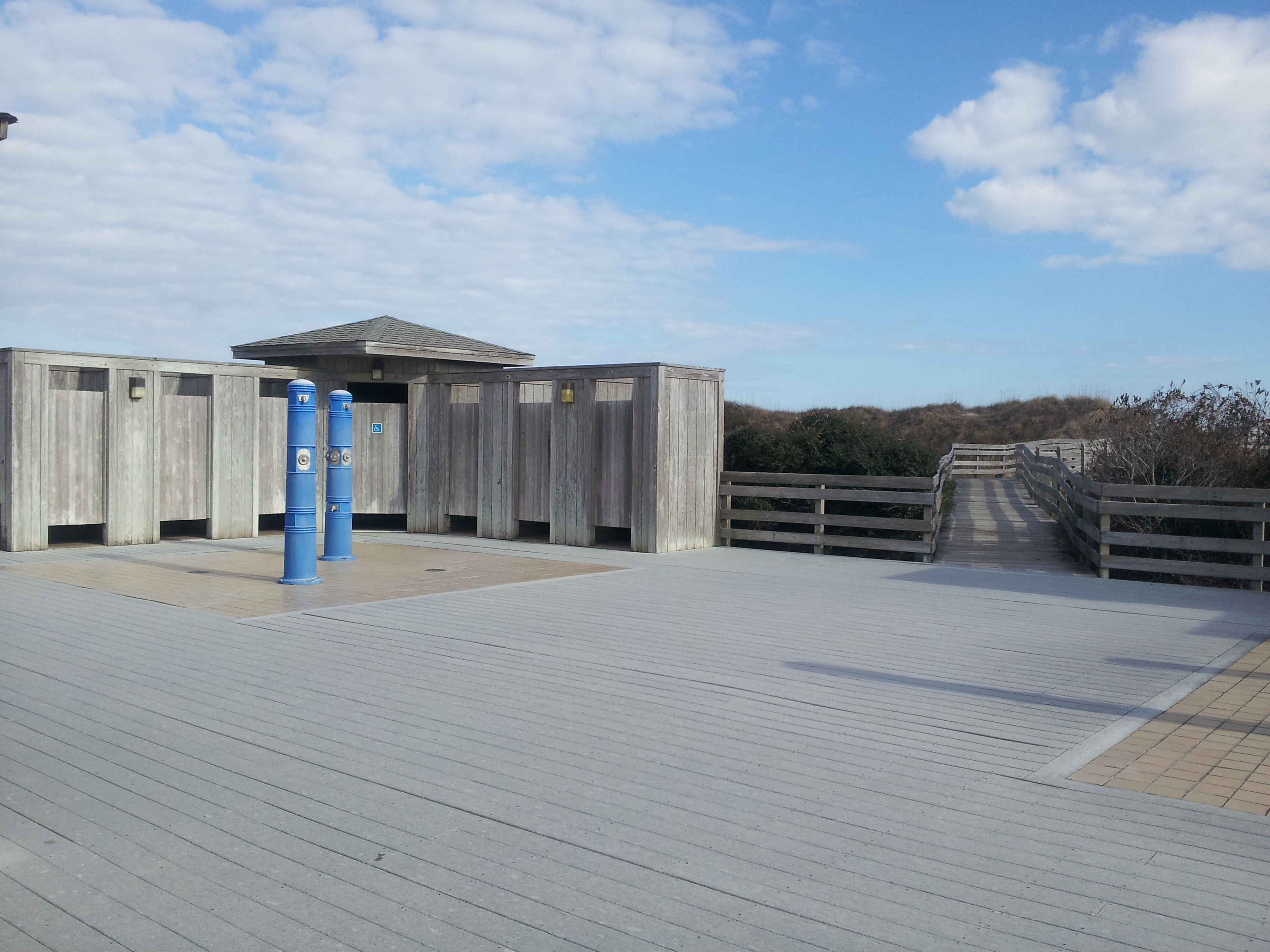
I stopped at one of the beach access points for a break. It was a perfect place to take a picture of the showers and changing rooms available for beach dwellers. I sent it off to my French friend who had mocked American modesty and introduced me to changing clothes on the beach.
“Now this is where you change into a suit!” I tagged the photo.
She reminded me that changing rooms are for sissies.
I chuckled. I do miss France.
The walk on the beach was cold, windy and beautiful. Storm clouds brewed in the distance and the sunbeams were bursting through the clouds as if creating a religious experience. How can you not take a moment to breathe it in? Let the beat of the waves adjust your internal rhythm? Find perspective in the very existence of an ocean so deep and wide?
It’s easy to lose yourself in the stress of life. Work-life balance is always an issue, but removing work from the equation doesn’t always equal life. Often, the unemployed are too stressed about the future to actually take time to live. How will I pay the bills? What if I lose my home? My car? The fear for the future takes over and they are either overcome with a paralyzing depression, an unfocused anxiety or an obsession for the job search. It’s one of those tragic points in life when excuses gain enough weight to appear as truths.
Sometimes looking out over the ocean reminds me that nothing is impossible.
I could walk on the beach for hours, but I should be on my way. Pea island is only a few miles up the road and I hear it has a wildlife refuge. Maybe I can drink my coffee with migrating fowls and seas turtles.
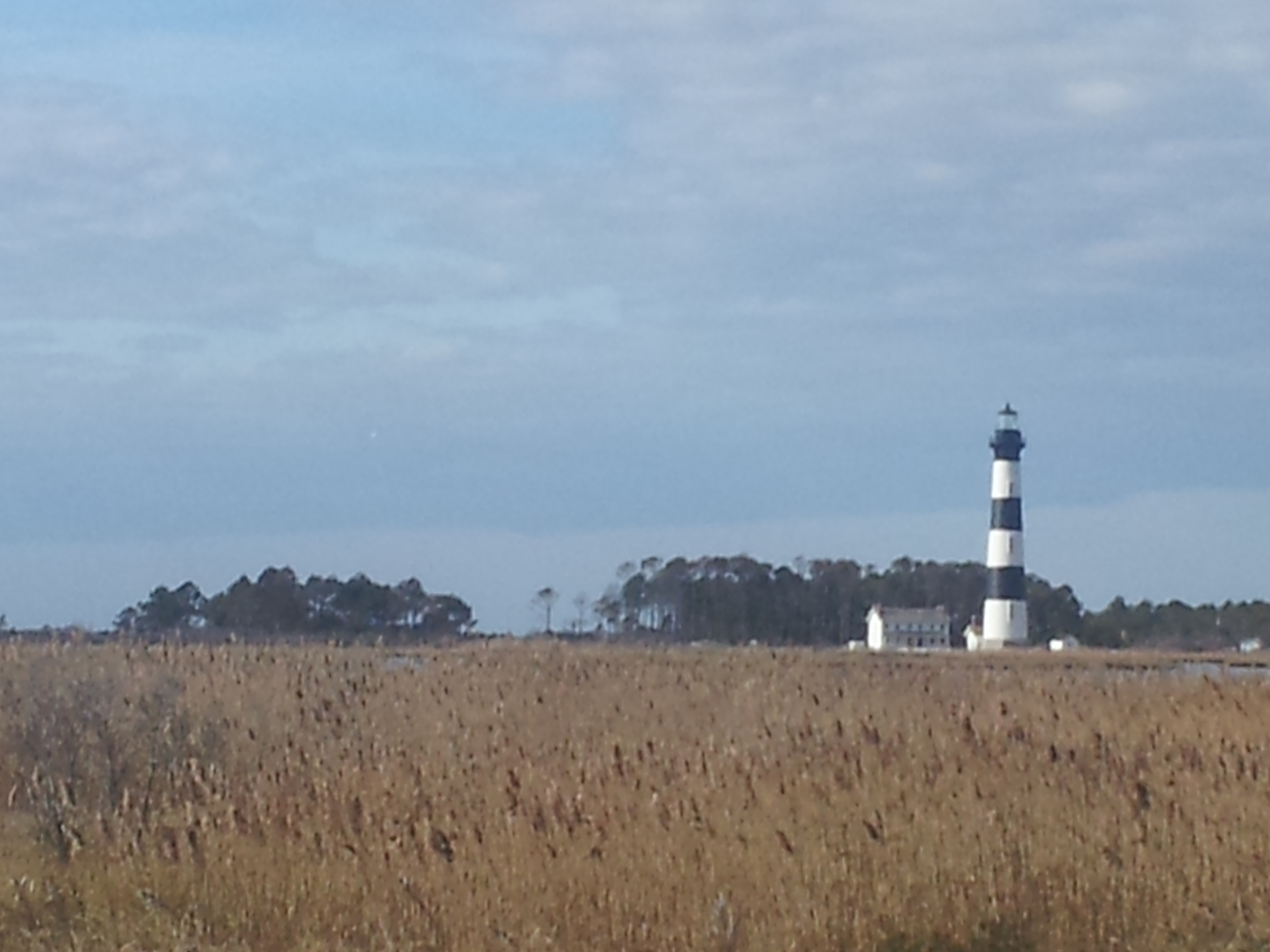
But wait! There’s a lighthouse.
I pull the car to the side of the road and climb on the roof of the car to get a good picture.
A man is standing nearby wearing waders and chewing tobacco as he patiently awaits the tug on his fishing line. He laughs at me.
“She’s perty, ain’t she?” Ah the extreme southern accent! I mock my own, but try to behave with those who have it worse.
I discovered his name was Roger, and he explained the Bodie Island Lighthouse is actually the thirst attempt to illuminate the dangerous stretch of coast between Cape Hatteras and Currituck Beach.
Bodie Island Lighthouse, North Carolina
“The keeper’s cottage has a visitor center,” he explained. “I don’t know if it’s open since this time of year we depend on volunteers to run most everything. You could try, M’am. It has a good amount of history if you’re into it.”
Sadly, it was closed. But there was a chatty groundskeeper who told me quite a bit about the structural issues with the lighthouse and the funding problems over the years that prevented proper historical preservation. He also shared some folklore regarding the “Graveyard of the Atlantic.” The treacherous currents, shoals and storms along this coast have provided a wealth of history relating to shipwrecks, lighthouses, heroes and ghosts. You can only really appreciate these stories as delivered by the locals.
By the time I had walked along the path of the wildlife refuge and taken advantage of the many photo opportunities along the way, I realized I’d better stay focused or I’d miss the ferries that would take me back to the mainland. There are two of them. The Ocracoke Ferry is only a 30 minute ride (though the wait at the start can take some time). The second ferry however is over 2 hours long.
After taking some pictures and tweeting with my friends, I grabbed my coffee from the car and curled up on the floor of the ferry beside a biker who was snuggled beneath his sleeping bag reading a book. He was traveling cross country. He’d been laid off and was heading back to his hometown in Arizona. There was every reason to panic, to focus on the down side, to say he may have the time but not the money to take the time to enjoy the view. He hadn’t. When life had dealt him the blow, he’d decided to sell his house and make the cross country trip home a life experience. He’d decided to let the future take care of itself. He’d planned for the future and it was stripped from him with the cut of a corporate budget. Perhaps it was time for a new outlook, a new adventure. He may never get the time to do this again.
“Besides,” he said. “Is it really that healthy to live in fear?”
I like him immediately.
My 10 hour drive home was entering its second day. I wasn’t going to worry. I could send out resumes from home, or from the road. I could stress over my situation in the confines of my town, or I could seek peace and direction in this detour.
“I’ll share a section of my sleeping bag if you share some of that coffee,” he offered.
I did more than that. For the next hour, I shared a journey.
It’s an homage to my mother and a strangely appealing step in the mourning process. More importantly, it has shed some light into the dark recessess of a wandering soul, specifically revealing the metaphor “I am a lighthouse.”
There’s a certain lore surrounding Lighthouses: the remote tower of strength, lighting the way, directing boats through perilous waters, and guiding the lost through the storm. And then there’s the mythos of the lonely lighthouse keeper, cut off from the world, faithful to a greater cause than self. Through my lighthouse journeys these past few months, I have found myself relating to this image more than I would like, and yet less troubled by the notion with the passing of time. I can appreciate the ironies
My journey home from Baltimore sent me along the eastern coast, where many lighthouses remain as both historical monuments and functional forms of navigation.
Naturally, I stopped.
It’s not uncommon to find a lighthouse on a military base. As the lighthouse protects the seafaring traveler from dangers and hazards so they may find safe passage, the military guards that same harbor to prevent dangers from passing the borders. My stop at the Cape Henry Lighthouse brought me to the gates of the Fort Story Army base.
Now, I’ve been on military bases before so I was prepared for the usual protocols. Unfortunately I forgot the most important rule: Don’t do anything until they tell you.
They search your car at the gate. I was prepared and ready…and moved too soon. I opened my door while the soldier was still looking at my paperwork. He went for his gun.
What???
I froze, of course. I must have looked like a deer facing the headlights because he smiled, though he remained tense and alert.
“I moved too soon,” I said the obvious.
“You’ve done this before.” He speaks the obvious too. “Generally you’re not supposed to get out the car until I tell you. I need to ascertain if you’re a danger.”
I can understand that, but now I’m nervous. When I’m nervous I go for humor or sass. With a good-looking soldier, I go for both apparently.
“Did you want to search me?”
He stared at me blankly.
“I figured,” I instantly responded. “I’m generally not that lucky.”
He grinned.
“I’m here to see the lighthouse.” See, I am capable of regaining my composure.
“You’ve been on base before?” He asked.
“Not on this one,” I answered. “I’ve been on other bases so I understood the process – thought I’d get out of the car and move things along. Good to know my moves bring out the guns.”
He laughed. It was a real laugh from deep within that transformed the hardened features of this very disciplined soldier.
“I’m going to let you get out of the car,” he said, and instructed me to open all of the car doors, the hatch and the hood. I followed instructions well.
“You can close them,” he said from behind me. What? I only just finished!
“You already checked me out?”
“Oh, yes,” he grinned. “I followed your every move.”
Now I laughed. He was cute. What was I here for again?
He gave me directions to the lighthouse explaining I shouldn’t go beyond the flashing lights.
“If you pass them, you’ve gone too far and you’ll enter a restricted area,” he leaned toward me. “Then I will have to search you and put you in the brig.”
“You say the nicest things,” I teased, dramatically fluttering my eye lashes.
He grinned. “And you have made my day.”
Traffic was building up behind me, so I couldn’t stay. It was a sad moment for me. But I pushed forward and found the lighthouse. Only, there were two of them!
The original was manned by the historical society. It was made of aquia creek sandstone, the same bricks that make up the White House. A little history revealed the top of the lighthouse was blown off during a hurricane in the 1950s. It was rebuilt and in 1964 became a historical preservation landmark. I walked the spiral staircase to the top of the 90 foot structure and enjoyed the view. Specifically the shore and the new lighthouse across the way.
The new lighthouse is cast iron and wrought iron construction, and stands 157 feet tall. It is an active lighthouse, fully automated and not open for public tours. It does make for beautiful photos, especially from the adjacent memorial garden leading up to the beach.
The restrictions of the base is limiting for tourists – it’s not as if you can hang out on the beach and enjoy water sports – but this is an enjoyable short excursion in Virginia Beach. For lighthouse enthusiasts or history buffs, it’s a must see. For others, it’s a nice detour if you’re bored. For single women or gay men, it’s anticlimactic after the gate search.
As I left, I waved to the soldier.
“You didn’t pass the flashing lights,” he called out. “I’m impressed.”
“We could always pretend I did,” I said. “Your brig or mine?”




 by G. Anne Bassett